
Bitfinex Review
Editorial record: June 1, 2026
Trading Fees
0.2% / 0.2%
Cryptocurrencies
200+
Founded
2012
Source status
Sources linked
No provider on this page operates or endorses InsideCryptoReview. Some links are affiliate links. We can earn a commission if you use them. A provider cannot approve or change editorial copy before publication. Read our editorial policy.
Risk Disclaimer
Cryptocurrency trading and investing involve a substantial risk of loss. Prices can change significantly in a short period, and you can lose some or all of your invested capital. This page gives information and does not give financial, investment, or legal advice. Check current provider terms and assess your risk before you make a financial decision. InsideCryptoReview can earn a commission from an affiliate link. A provider cannot approve or change our editorial copy. Past performance does not guarantee future results. Invest only an amount that you can afford to lose.
Editorial desk producing public-source crypto product research. Pages identify their evidence and limitations; hands-on testing is claimed only when dated evidence is shown.
Last Updated: June 1, 2026
Editorial MethodBitfinex launched in 2012 and is operated by iFinex Inc., which also owns Tether. It lists BTC/USD markets, advanced order types, margin trading, a P2P lending market, and the Honey Framework. The 2016 hack and the Tether relationship are material risks. U.S. residents are ineligible. Check current terms before you use the platform.
Bitfinex
Public sourcesOur Editorial Verdict
Bitfinex offers advanced order types, spot margin, and P2P funding. The product design can suit experienced users, but product access and terms vary by region.
Bitfinex and Tether share parent company iFinex Inc. The relationship has been the subject of regulatory action and ongoing scrutiny. Bitfinex also experienced a 2016 security breach. Review the current custody terms, legal disclosures, and Tether reserve information before you deposit funds.
May suit: Users who understand trading and custody risks and want to compare Bitfinex's order types, margin, and funding products.
Consider another exchange if: You need access in the United States, a simpler interface, deposit protection, or stronger local regulatory safeguards.
Bitfinex overview
Bitfinex launched in 2012 and is operated by iFinex Inc. iFinex also owns Tether. Review that relationship, the related legal disclosures, and the product terms before you use Bitfinex.
The Tether Connection: What You Need to Know
Bitfinex and Tether share a parent company. iFinex Inc. owns both entities. This corporate structure led to a 2021 New York Attorney General settlement. iFinex paid $18.5 million and accepted enhanced transparency requirements. The NYAG alleged that Tether reserves covered an $850 million Bitfinex shortfall. iFinex neither admitted nor denied wrongdoing.
The shared corporate structure creates correlation risk. A material Tether event could affect Bitfinex. Coinbase and Circle are separate companies, for example.
Tether publishes reserve attestations. An attestation is not an audit. Review the latest attestation, legal disclosures, and the assets in the reserve report before you rely on the token or the platform.
What Bitfinex Actually Offers
The main documented features and limits are:
- Order Type Depth: Bitfinex lists trailing stops, fill or kill, immediate or cancel, scaled orders, hidden orders, and OCO orders. Iceberg orders can hide part of an order size. Check available order types and execution terms before you trade.
- Margin Trading (Up to 10x on Spot): Bitfinex pioneered crypto margin trading, and the infrastructure reflects that history. The isolated margin system means a losing position in one pair does not threaten your collateral in another. Across BTC/USD, ETH/USD, and altcoin pairs during volatile conditions, the liquidation engine predictable and fair. The margin funding rates are transparent because they come from the P2P lending market rather than being set by the exchange.
- P2P Lending Market: No other major exchange offers this at the same scale. You can lend your BTC, ETH, USDT, or other supported assets to margin traders and earn interest. Rates fluctuate with demand. Daily rates on USDT have been observed between 0.01% and 0.08%, translating to roughly 3.6% to 29% APY depending on market conditions. Rates spike during volatility. The auto-renew feature makes it mostly hands-off once configured. The catch: your funds stay on Bitfinex while lending, so you carry platform risk.
- Derivatives (Up to 100x): Perpetual swaps and futures on major pairs have leverage up to 100x. Extreme leverage can cause rapid liquidation. Use lower leverage and defined risk limits.
- OTC Desk: Bitfinex lists an OTC desk for block trades above $100,000. Check its current execution terms and fees.
- Honey Framework: Bitfinex provides an open-source algorithmic trading framework. Its WebSocket API supports real-time strategy execution. Review the current API documents before you use it.
- Bitfinex Pay: Merchant payment processing in crypto. This separate service is mainly relevant to merchants.
- Bitfinex Securities: A tokenized securities platform that launched in recent years. Still early stage, but it signals where iFinex sees the industry heading.
- Paper Trading: Simulated trading with live market data — ideal for testing a new strategy before committing capital. The paper trading environment mirrors the real platform accurately.
- UNUS SED LEO Token: The native exchange token was issued in 2019 after the Crypto Capital fund seizure. Holding LEO can give fee discounts. Compare the discount with token price risk and your expected trading volume before you buy it.
Platform Evolution Since the Early Days
Bitfinex has changed since the 2016 hack. It lists the Honey Framework and Bitfinex Intelligence analytics platform. Review current REST and WebSocket API documents, rate limits, and security terms.
The exchange has not chased the retail market. You will not find a simplified mode, gamified trading, or earn programs designed for beginners. Everything about Bitfinex signals that they want professional and institutional flow, and the $10,000 minimum for fiat deposits reinforces that positioning.
Who Trades on Bitfinex?
Based on published product information and public user feedback:
- Professional Day Traders who need order types beyond what Binance or Coinbase offer. The interface complexity becomes an advantage once you know your way around. Keyboard shortcuts and customizable workspaces speed up execution.
- Whale and Institutional Traders executing six and seven-figure positions. The deep BTC/USD book and OTC desk handle large orders with minimal slippage. Sub-accounts and advanced reporting support institutional workflows.
- Margin Traders who want transparent funding rates from a real P2P market rather than exchange-set rates.
- Yield Seekers using the lending market for passive income on crypto holdings. Returns beat most DeFi lending protocols during high-volatility periods, with less smart contract risk but more platform risk.
- Algorithmic Traders building strategies on the Honey Framework or raw API. The execution reliability and order type variety make Bitfinex a strong venue for automated trading.
Bitfinex is NOT for beginners. The interface assumes you already know what a stop-limit is, how margin works, and what an order book tells you. There are no tutorials inside the platform, no simplified trading view, and no tooltips explaining basic concepts. If you are new to trading, spend six months on Kraken or Coinbase first. You will save money on mistakes.
Bitfinex Fees Explained
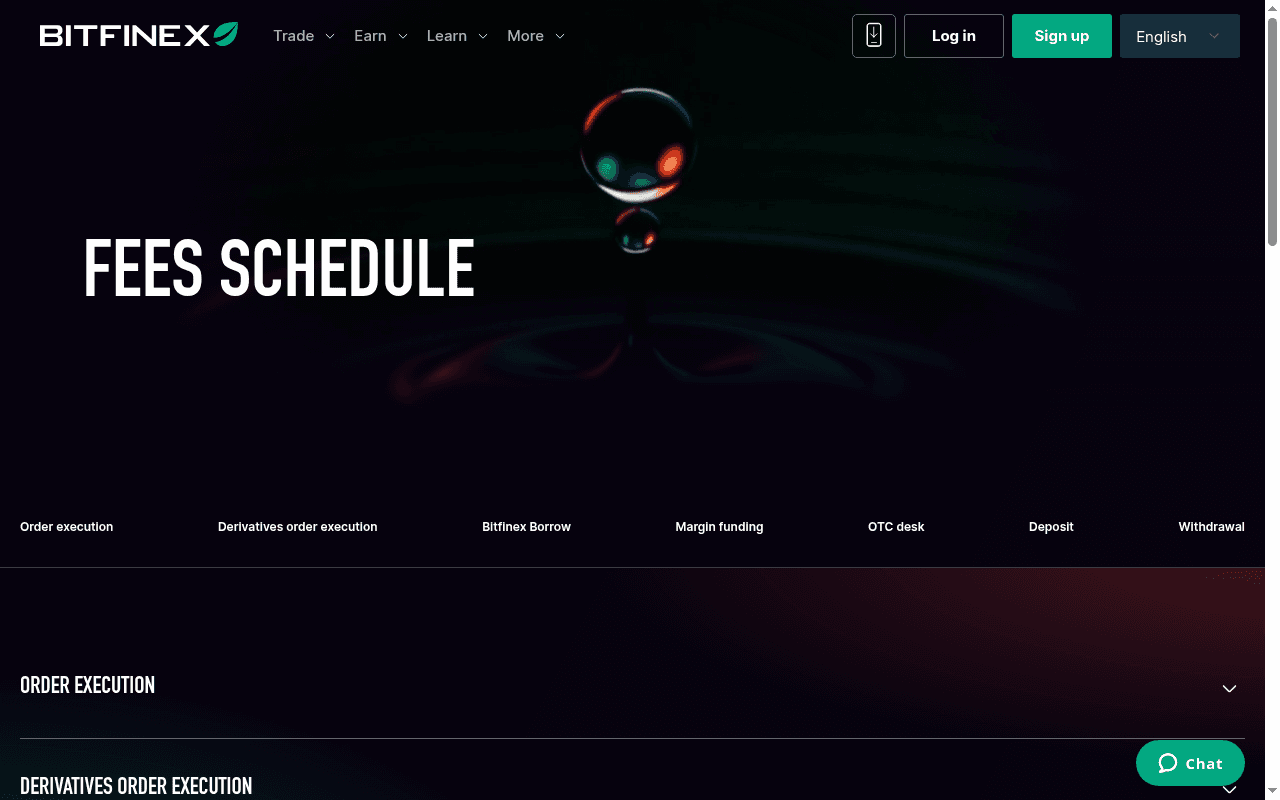
Bitfinex publishes a tiered fee schedule. Maker and taker fees vary by 30-day volume and product. Check the current schedule before you trade.
Spot Trading Fees: The Full Tier Schedule
| 30-Day Volume (USD) | Maker Fee | Taker Fee |
|---|---|---|
| $0 - $500K | 0.100% | 0.200% |
| $500K - $1M | 0.080% | 0.200% |
| $1M - $5M | 0.060% | 0.200% |
| $5M - $7.5M | 0.040% | 0.200% |
| $7.5M - $10M | 0.020% | 0.200% |
| $10M - $15M | 0.000% | 0.185% |
| $15M - $20M | 0.000% | 0.175% |
| $20M - $30M | 0.000% | 0.150% |
| $30M+ | 0.000% | 0.100% |
The schedule lists lower maker fees at higher volume tiers. Compare the final cost, spread, and execution price for your expected order size.
For a trader doing $2M/month in mostly limit orders, the effective maker fee is 0.06%. That is genuinely cheap and beats Kraken's 0.16% maker fee by a wide margin. At that volume, Bitfinex saves you roughly $2,000/month versus Kraken on maker fees alone.
LEO Token Fee Discounts
Holding UNUS SED LEO tokens in your Bitfinex wallet gives you percentage discounts on top of the volume tiers:
- 5,000 LEO: 5% discount on trading fees
- 10,000 LEO: 10% discount
- 50,000 LEO: 15% discount
- 100,000+ LEO: 25% discount (maximum)
LEO cost and fee discounts can change. Calculate the current token cost, fee discount, and market risk before you buy LEO for a fee reduction.
Derivatives Fees
| Product | Maker Fee | Taker Fee | Funding Rate |
|---|---|---|---|
| Perpetual Swaps (BTC) | 0.020% | 0.065% | Variable (8-hour) |
| Perpetual Swaps (ETH) | 0.020% | 0.065% | Variable |
| Perpetual Swaps (Altcoins) | 0.020% | 0.065% | Variable |
| Futures Contracts | 0.020% | 0.065% | N/A |
These are competitive but not the lowest available. Bybit charges 0.01%/0.06% at base tier, and OKX offers comparable rates with VIP programs. Where Bitfinex earns back the slight fee premium is execution quality. Derivatives fills during sharp BTC selloffs land within 0.01% of the displayed price on the BTC perpetual. On thinner altcoin perps, the difference versus cheaper venues is negligible after accounting for slippage.
Withdrawal Fees
| Asset | Network | Fee | Minimum |
|---|---|---|---|
| BTC | Bitcoin | 0.0004 BTC | 0.0004 BTC |
| ETH | Ethereum | 0.004 ETH | 0.004 ETH |
| ETH | Arbitrum | 0.0001 ETH | 0.001 ETH |
| USDT | Tron (TRC20) | 1 USDT | 5 USDT |
| USDT | Ethereum (ERC20) | 20 USDT | 20 USDT |
| USDT | Polygon | 0.5 USDT | 5 USDT |
| USD | Bank Wire | 0.1% (min $20) | $10,000 |
| EUR | Bank Wire (SEPA) | 0.1% (min 20 EUR) | 10,000 EUR |
| GBP | Bank Wire | 0.1% | 10,000 GBP |
Crypto withdrawal fees are reasonable and roughly track network costs. Always choose the cheapest network available. Withdrawing USDT via Tron costs $1 versus $20 on Ethereum. That is a 20x difference for the same asset.
The $10,000 Fiat Minimum
This is not a bug. Bitfinex sets a $10,000 minimum on all fiat deposits and withdrawals via bank wire. The 0.1% processing fee on top of that minimum means you are paying at least $10 on a minimum-size fiat transaction. Processing takes 5-10 business days.
If you have less than $10,000 to work with, you cannot use fiat on Bitfinex at all. You need to deposit crypto from another exchange or wallet. For traders used to Coinbase or Kraken where you can deposit $100 via ACH, this is a hard barrier. Bitfinex is not interested in small retail accounts, and the fiat minimum makes that explicit.
How Bitfinex Fees Compare to Kraken, Binance, and Coinbase
| Exchange | Maker Fee | Taker Fee | Fiat Minimum | Best For |
|---|---|---|---|---|
| Bitfinex | 0.10% | 0.20% | $10,000 | Pro makers, whale accounts |
| Binance | 0.10% | 0.10% | ~$15 | Lower taker fees, global access |
| Kraken | 0.16% | 0.26% | ~$10 | Regulatory compliance, US access |
| Coinbase | 0.40% | 0.60% | $0 (ACH) | US insurance, beginner-friendly |
- vs. Binance: Bitfinex takers pay 0.10% more at base tier. That is $100 more per $100K in taker volume. Binance is cheaper for takers, period. But Bitfinex offers deeper BTC/USD books, the lending market, and more order types. For large limit orders, Bitfinex execution quality can offset the fee gap through better fills.
- vs. Kraken: Bitfinex undercuts Kraken on both maker (0.10% vs 0.16%) and taker (0.20% vs 0.26%) fees. On $500K monthly volume, you save $800 on Bitfinex versus Kraken. But Kraken has never been hacked, holds proper regulatory licenses, and serves US traders. The security and compliance advantages may be worth the fee premium for risk-conscious traders.
- vs. Coinbase: Bitfinex is dramatically cheaper. A $100K trade costs $100-200 on Bitfinex versus $400-600 on Coinbase at base tier. Coinbase charges a premium for FDIC insurance, regulatory compliance, and a simplified interface. US traders who cannot access Bitfinex do not have a choice here anyway.
Hidden Costs That Add Up
Beyond the published fee schedule, several costs are not immediately obvious:
- Altcoin spreads: Less liquid altcoin pairs on Bitfinex carry wider spreads than you would see on Binance. Spreads on mid-cap alts run roughly 0.2-0.5% wider, effectively increasing trading cost beyond the posted fee.
- Funding rates on derivatives: If you hold perpetual swap positions through multiple funding intervals, the rates can eat into profits during strongly trending markets.
- Margin funding costs: When you borrow for margin trades through the P2P market, rates fluctuate with demand. During a bull run, borrowing costs can spike to 0.1%+ daily.
- Fiat processing time: The 5-10 business day wait for bank wires means your capital is idle. That is an opportunity cost, especially for active traders who need to move money quickly.
- No inactivity fee: Bitfinex does not charge for dormant accounts, which is worth noting since some competitors do.
Security Analysis: Is Bitfinex Safe?
Bitfinex's security history includes a 2016 breach. Its current security controls do not remove custody, market, or regulatory risk.
The 2016 Hack: What Actually Happened
In August 2016, attackers exploited a vulnerability in Bitfinex's multi-signature wallet setup, which had been built in partnership with BitGo. They stole 119,756 BTC, worth about $72 million at the time. At Bitcoin's all-time high, those coins were worth over $7 billion. The breach ranked among crypto's largest exchange hacks.
The attack was sophisticated. It was not a brute-force password crack or a social engineering scam. The hackers found a way to manipulate the multi-sig approval process and authorize withdrawals that should have been blocked. BitGo's co-signing was supposed to prevent exactly this scenario, but the implementation had weaknesses that the attackers identified and exploited.
How Bitfinex Responded
Bitfinex continued operating after the hack. It introduced a recovery mechanism that drew criticism at the time:
- Trading was halted within hours.
- Bitfinex applied a 36.067% haircut to every user account, proportionally distributing the loss regardless of whether your specific funds were stolen.
- Users received BFX tokens representing their losses, 1:1 with USD value. These tokens were tradeable on the platform.
- Over the following eight months, Bitfinex redeemed every BFX token at full face value. If you held your tokens instead of panic-selling, you got 100% of your money back.
- In 2022, US law enforcement recovered approximately 94,000 of the stolen Bitcoins from two people who had been sitting on them. That recovery process has continued.
Bitfinex later redeemed the BFX tokens at face value. Past reimbursement does not guarantee future coverage.
Current Security Infrastructure
Since the 2016 hack, Bitfinex rebuilt its security stack. The current setup is substantially improved:
| Security Feature | Status | Assessment |
|---|---|---|
| Cold Storage | 99.5%+ in geographically distributed locations | Among the highest percentages in the industry |
| 2FA | Mandatory for all accounts | Supports Google Authenticator, U2F hardware keys (YubiKey), email. Avoid SMS. |
| IP Whitelisting | Available | Restricts account access to approved IP addresses. Works reliably. |
| Withdrawal Address Whitelisting | Available | Withdrawals only go to pre-approved addresses with mandatory waiting period for new ones. |
| Anti-Phishing Code | Available | Unique code appears in all legitimate Bitfinex emails. Helps identify phishing. |
| Session Management | Active | View all connected devices and sessions. Terminate suspicious ones instantly. |
| API Key Permissions | Granular | Create read-only, trade-only, or full-access keys. |
| Login History | Complete log | IP addresses, timestamps, device info for every access attempt. |
| Bug Bounty Program | Active | Rewards up to $10,000+ for critical vulnerability reports. |
| PGP Email Encryption | Optional | For users who want encrypted email communications with Bitfinex. |
The withdrawal address whitelisting is well-implemented. After adding a new address, there is a mandatory cooling period before it becomes active. Combined with U2F hardware key 2FA, this creates a strong barrier against unauthorized withdrawals even if someone gains access to your login credentials.
The Systemic Risk Question: Tether and iFinex
This is where the Bitfinex security conversation gets complicated. Technical security is one thing. Corporate and systemic risk is another.
Bitfinex and Tether share the same parent company. The 2021 NYAG settlement addressed an $850 million Bitfinex shortfall. It related to the Crypto Capital payment processor seizure. iFinex paid $18.5 million and accepted enhanced transparency without admitting wrongdoing.
What does this mean for your funds on Bitfinex?
- If Tether faces a serious regulatory crackdown or confidence crisis, Bitfinex will likely be affected. The two entities share financial infrastructure and corporate leadership.
- Tether's quarterly attestations show improved reserve backing as of 2026, but these are not full audits. There is no Big Four accounting firm signing off on a complete audit of Tether's reserves.
- The regulatory status of both Bitfinex and Tether remains uncertain. Neither entity holds major regulatory licenses in the US, EU, or other significant jurisdictions.
To be precise: there is no public evidence that Bitfinex user funds are directly commingled with Tether reserves. But the corporate relationship creates correlation risk. If something goes wrong with Tether, you do not want your trading capital sitting on Bitfinex when it happens. This is a risk that does not exist on Kraken, Coinbase, or Gemini.
No Deposit Insurance
Bitfinex offers zero deposit insurance. Compare that to:
- Coinbase: FDIC insurance on USD deposits up to $250,000, commercial insurance on crypto assets
- Gemini: Commercial insurance on custodied digital assets, NY BitLicense holder, SOC 2 certified
- Kraken: No insurance either, but licensed in multiple jurisdictions including as a Wyoming SPDI bank, and has never been hacked
If Bitfinex were breached again, there is no insurance backstop. You are relying entirely on Bitfinex's security measures and their willingness to make users whole, as they did after 2016. That is a meaningful difference from insured platforms.
Security Comparison with Competitors
| Exchange | Hacked? | Cold Storage | Insurance | Regulation |
|---|---|---|---|---|
| Bitfinex | Yes (2016) | 99.5% | None | Minimal (BVI) |
| Kraken | Never | 95%+ | None | Licensed in multiple jurisdictions, WY SPDI |
| Coinbase | Never | 98% | FDIC + commercial | Full US regulation |
| Gemini | Never | Undisclosed | Yes | NY BitLicense, SOC 2 |
| Binance | Yes (2019) | 90%+ | SAFU fund | Varies by jurisdiction |
Security factors
- Bitfinex states that it uses cold storage, mandatory 2FA, U2F support, withdrawal whitelisting, and anti-phishing tools.
- The 2016 hack is part of its public record.
- The Tether relationship and BVI jurisdiction remain relevant custody and regulatory risks.
- Bitfinex does not state that it provides deposit insurance. Check its current terms.
Practical Recommendation: Use Bitfinex as an active trading platform, not a storage facility. Keep working capital on the exchange for your trades. Move profits and long-term holdings to hardware wallets or insured custodians. Enable every security feature available, especially U2F 2FA and withdrawal address whitelisting. Do not leave six figures sitting idle on Bitfinex.
Who Should Use Bitfinex?
Bitfinex has a dense trading interface, a stated fiat minimum, and advanced order controls. These features can make the platform less suitable for users who need a simple purchase flow.
Professional Day Traders
Bitfinex lists OCO, hidden, iceberg, and scaled orders. These order types can support different execution plans, but they do not remove market risk.
Execution is reliable during volatile sessions, and the interface, once you learn the layout, allows faster strategy execution than simplified platforms. Keyboard shortcuts help. Customizable workspaces help more. You can set up different layouts for scalping versus swing trading versus monitoring the lending market.
Compared to Kraken, Bitfinex gives you wider order type variety. Kraken has strong infrastructure too, but it does not offer hidden orders, iceberg orders, or the same depth of customization. If order types are your priority, Bitfinex wins.
Whale and Institutional Traders
Check the BTC/USD order book before you place a large order. Bitfinex lists an OTC desk for trades above $100,000. Review its execution terms and fees.
Institutional features include sub-accounts, reporting, and API access. Check current BTC/USD order-book depth and estimated execution price for your order size.
Margin Traders
Bitfinex pioneered crypto margin trading and the infrastructure shows it. Isolated margin means a blowup in one pair does not cascade into your other positions. The liquidation engine behaves predictably, and margin call notifications arrive promptly.
The P2P funding market uses crypto supplied by other users. Current funding rates appear before you enter a position. Compare the displayed carrying cost with fixed-rate margin products before you borrow.
Yield Earners via the Lending Market
No other major centralized exchange offers P2P lending at this scale. You deposit BTC, ETH, USDT, or other supported assets, set your desired rate and duration (2-30 days), and margin traders borrow from you. The auto-renew feature relends your funds automatically when loans mature.
Returns between 3.6% and 29% annualized on USDT have been observed depending on market conditions. Bull market weeks push rates higher; calm periods settle toward the lower end. The returns beat most DeFi lending protocols during high-volatility periods, and you avoid smart contract risk. The tradeoff is platform risk: your funds sit on Bitfinex the entire time you are lending.
Only lend amounts you would be comfortable losing if Bitfinex experienced a catastrophic event. This is not insured yield.
Algorithmic Traders
The Honey Framework is an open-source toolkit for trading algorithms. The WebSocket API supports data feeds and order management. Paper trading can use market data without risking capital.
Bitfinex documents API key permissions for reading, trading, and withdrawals. Use a trade-only key where possible. Review current API limits and security controls before you run a bot.
NOT For: Beginners
Bitfinex can be difficult for new traders. It has no simplified mode or guided first-trade flow. Learn trailing stops, margin liquidation, and order-book basics before you trade.
The interface uses dense terminology and advanced controls. Start with a small amount and learn the controls before you trade. Compare locally available services as well.
NOT For: US Residents
Bitfinex stopped serving U.S. residents in 2017. Using a VPN can violate its terms and risk account restrictions. Check its current eligibility policy before you open an account.
U.S. residents can compare locally available services, including Kraken, Coinbase Advanced Trade, and Gemini. Check current product access and regulatory status.
NOT For: Risk-Averse Investors or Long-Term Holders
The 2016 hack, Tether relationship, BVI jurisdiction, and lack of stated deposit insurance create material custody risks. Review these risks before you hold assets long term. A hardware wallet can reduce exchange custody exposure.
NOT For: Small Accounts
The $10,000 fiat minimum can limit smaller accounts to crypto deposits. Users who need simpler controls can compare other available services.
NOT For: People Concerned About Tether
If you have studied the Tether situation and concluded the iFinex corporate relationship represents unacceptable systemic risk, using Bitfinex puts you inside that ecosystem. You will interact with USDT, you will trade on infrastructure managed by the same parent company, and you will carry the correlation risk. That is a completely rational reason to choose a different exchange. Kraken is the closest alternative in terms of professional features without any stablecoin affiliations.
What Real Users Say About Bitfinex
Public reviews can describe individual experiences, but they do not verify platform-wide performance. Check current, attributable sources before you rely on a rating.
Trustpilot Reviews
Ratings, review counts, and review themes can change. Account reviews, verification, and withdrawal delays are material risks to assess in the current terms.
Common complaints in user reviews include:
- Some reviews report extended holds during enhanced due diligence.
- "Support tickets go unanswered for days" - Customer service response times appear to be a significant pain point
- "Withdrawal delays during volatile markets" - Several users report slower processing when markets move sharply
However, positive reviews highlight the platform's trading capabilities:
- "Best liquidity for large BTC orders I've found" - Professional traders consistently praise execution quality
- "The lending market is genuinely useful for passive income" - The P2P funding feature receives solid marks
- "Advanced order types work exactly as expected" - Technical traders appreciate the reliability
App Store Ratings
The Bitfinex mobile app shows significantly better ratings than the Trustpilot reviews might suggest:
- iOS App Store: 4.2 out of 5 stars from approximately 2,800 reviews
- Google Play Store: 4.0 out of 5 stars from approximately 8,400 reviews
App store reviews tend to focus more on functionality than customer service, which explains the discrepancy. Users consistently praise the comprehensive feature set that mirrors the desktop experience. Criticism centers on the steep learning curve and occasional stability issues during extreme market volatility.
Notable iOS feedback:
- "Full trading functionality on mobile - finally a pro-grade app" (5 stars)
- "Interface takes weeks to learn but worth it once you do" (4 stars)
- "App crashed during the March volatility spike, cost me a position" (2 stars)
Notable Android feedback:
- "Does everything the desktop does, impressed with the API integration" (5 stars)
- "Needs better tutorials for new users" (3 stars)
- "Withdrawal confirmations sometimes delayed in the app" (3 stars)
Reddit Sentiment
Browsing r/Bitfinex, r/CryptoCurrency, and r/BitcoinMarkets reveals a community that views Bitfinex with cautious respect. The Tether connection remains the dominant concern in discussions, with regular debates about systemic risk. However, traders who actually use the platform frequently defend its trading capabilities.
Recurring Reddit themes across these discussions:
- Positive: Deep liquidity praised for large orders, lending market seen as unique value proposition, professional traders recommend for serious trading
- Negative: Tether FUD (Fear, Uncertainty, Doubt) is persistent, hack history still mentioned despite full user recovery, concerns about offshore jurisdiction
- Neutral: General consensus that it's not for beginners, recognition that US restrictions limit the user base
Forum posts describe the platform as advanced and difficult for inexperienced users. Treat each post as an individual opinion.
Overall User Sentiment Analysis
Public feedback describes both trading tools and support limitations. Trustpilot and app-store reviews can measure different user groups. Review current sources before you use Bitfinex.
Public feedback describes both trading tools and support limitations. Review current sources and product terms before you use Bitfinex.
Getting Started: Step-by-Step Guide
Bitfinex's interface and products can be complex. Read the product, margin, and custody terms before you create an account.
Step 1: Account Registration
- Go to bitfinex.com. Before entering any credentials, verify the URL and SSL certificate. Bitfinex phishing sites exist and they look convincing.
- Click "Sign Up" in the top right.
- Use an email address dedicated to financial accounts. Do not use your everyday personal email. Enable strong security on the email account itself (2FA on the email provider).
- Create a password with at least 12 characters mixing uppercase, lowercase, numbers, and symbols. Do not reuse it anywhere.
- Complete the captcha and submit.
- Check your inbox for the confirmation email. It usually arrives within 5 minutes. Check spam if needed.
- Click the verification link to activate your account.
Step 2: Identity Verification (KYC)
Bitfinex requires full KYC for most functionality. Given their regulatory history, they take compliance seriously. Here is what the process requires:
- Go to Account Settings and find the Verification section.
- Fill in personal details: full legal name, date of birth, nationality, residential address.
- Upload a government-issued photo ID. Passport, national ID card, or driver's license all work. The document needs to be current and clearly readable.
- Take a selfie for biometric matching. Some verification flows require you to hold your ID next to your face in the photo.
- Upload proof of address: utility bill, bank statement, or government letter dated within the past 3 months.
- Submit and wait. Review time varies by account and region. Check Bitfinex's current verification guidance.
- Enhanced verification tiers exist for higher withdrawal limits. These require additional documents.
Without completing KYC, you cannot deposit or withdraw fiat and your crypto functionality will be limited.
Step 3: Lock Down Your Security
Do this before depositing anything. Given the platform's history, security is not optional.
- Enable 2FA immediately. Use Google Authenticator or a YubiKey hardware key. Do not use SMS 2FA. SIM swapping attacks are real and crypto exchanges are common targets.
- Set an anti-phishing code. Bitfinex can add a custom code word to its account emails. Treat an email without the configured code as suspicious.
- Turn on withdrawal address whitelisting. Whitelisting limits withdrawals to pre-approved addresses. Adding a new address triggers a mandatory waiting period. This control can reduce unauthorized withdrawal risk.
- Enable login notifications. Get alerted when someone logs in from a new IP or device.
- Review active sessions regularly. Kill anything you do not recognize.
- Consider time-delayed withdrawals. This adds a 24-hour or longer delay to large withdrawals, giving you a window to catch unauthorized activity.
- Never share credentials. Bitfinex support will never ask for your password, 2FA codes, or API keys.
Step 4: Depositing Funds
Remember: $10,000 minimum for fiat. If you have less, deposit crypto instead.
For crypto deposits:
- Go to Wallet, then Deposit.
- Select the cryptocurrency you want to deposit.
- Choose the network carefully. USDT on Tron (TRC-20) costs $1 to withdraw later. USDT on Ethereum costs $20. Same asset, very different fees.
- Copy the deposit address. Triple-check it before sending. One wrong character sends your funds into the void.
- Send from your external wallet. Bitcoin typically needs 3 confirmations. Most crypto deposits credit within 30-60 minutes.
For bank wires ($10,000+):
- Select your fiat currency (USD, EUR, GBP, JPY).
- Copy the bank details exactly as shown, including all reference codes. Missing a reference code can delay your deposit by weeks.
- Initiate the transfer from your bank. Processing takes 5-10 business days.
- The sending bank account name must match your verified identity exactly.
Step 5: Your First Trade
The trading interface is dense. Do not let it intimidate you if you have experience on other exchanges.
- Navigate to the Trading section. You will see charts, an order book, recent trades, and the order entry form.
- Find your trading pair using the search bar or pair selector. Start with BTC/USD or ETH/USD where liquidity is deepest.
- Locate the order entry form.
- For your first trade, use a limit order. Set the price you want to pay, enter the amount, and submit. Limit orders charge 0.1% maker fees versus 0.2% taker fees for market orders. That 0.1% difference adds up over time.
- If you need instant execution, use a market order. It fills immediately at the best available price but costs more in fees and may slip on larger sizes.
- After placing your order, monitor it in the orders panel. Limit orders may take time to fill if the market does not reach your price.
Tips That Will Save You Money
- Use the paper trading feature before trading real money. It mirrors the live platform with simulated funds.
- Always use limit orders unless speed is critical. The fee savings are real.
- Start with BTC/USD and ETH/USD. These pairs have the tightest spreads and deepest books.
- Do not touch margin or derivatives until you are comfortable with the spot interface.
- Keep most of your crypto in a hardware wallet. Only deposit what you plan to actively trade.
- Test the withdrawal process with a small amount before depositing large sums. Make sure you can get your money out.
Bitfinex vs Competitors: Complete Comparison
How does Bitfinex stack up against other major exchanges? As a professional trading platform based in Hong Kong with a focus on the margin lending market, Bitfinex occupies a unique position. Here is a detailed comparison across the key dimensions for each platform.
Bitfinex vs Kraken vs Bitstamp vs Coinbase vs OKX
| Feature | Bitfinex | Kraken | Bitstamp | Coinbase | OKX |
|---|---|---|---|---|---|
| Founded | 2012 | 2011 | 2011 | 2012 | 2017 |
| Headquarters | Hong Kong | USA | Luxembourg | USA | Seychelles |
| Maker Fee | 0.10% | 0.16% | 0.30% | 0.40% | 0.08% |
| Taker Fee | 0.20% | 0.26% | 0.40% | 0.60% | 0.10% |
| US Available | No | Yes | Yes | Yes | No |
| Margin Trading | Yes (10x) | Yes (5x) | No | Yes (limited) | Yes (10x) |
| Lending Market | Yes (P2P) | No | No | No | Yes |
| Cryptocurrencies | 200+ | 200+ | 80+ | 250+ | 350+ |
| Fiat Support | USD, EUR, GBP, JPY | USD, EUR, GBP, CAD | USD, EUR, GBP | USD, EUR, GBP | Limited |
| Never Hacked | No (2016) | Yes | No (2015) | Yes | Yes |
| Regulatory Status | Offshore | US Licensed | EU Licensed | US Licensed | Offshore |
| Best For | Pro traders | Security-focused | European traders | US beginners | Global derivatives |
Key Takeaways:
- Bitfinex vs Kraken: Bitfinex offers lower fees (0.10% vs 0.16% maker) and the unique P2P lending market. However, Kraken has never been hacked, is licensed in the US, and offers better regulatory protection. Choose Bitfinex for advanced features and liquidity; choose Kraken for security and compliance.
- Bitfinex vs Bitstamp: Both are veteran exchanges from 2011-2012. Bitfinex has significantly lower fees and more advanced trading features. Bitstamp is better for European traders who prioritize EU regulation and simpler interfaces.
- Bitfinex vs Coinbase: Bitfinex fees are dramatically lower (0.10% vs 0.40% maker). Coinbase wins on ease of use, US availability, insurance protection, and beginner-friendliness. Professional traders outside the US should consider Bitfinex; US traders have no choice but Coinbase or Kraken.
- Bitfinex vs OKX: Both target professional traders with similar fee structures. OKX offers more cryptocurrencies and derivatives products. Bitfinex has the unique margin lending market and deeper liquidity for major pairs. Both are unavailable to US residents.
Pros & Cons
What We Like
- Among the deepest BTC/USD order books in crypto, handles six and seven-figure orders with minimal slippage
- Widest order type selection of any major exchange: OCO, trailing stop, iceberg, hidden, scaled orders
- Unique P2P margin lending market for earning yield on idle crypto (3-30% APY depending on conditions)
- Margin trading pioneer with isolated margin system and transparent P2P funding rates
- Honey Framework provides open-source algorithmic trading tools with solid API documentation
- OTC desk for block trades above $100,000 with dedicated execution and minimal market impact
- 99.5% cold storage with mandatory 2FA, U2F hardware key support, and withdrawal address whitelisting
- Paper trading environment mirrors live platform for strategy testing without risking capital
What Could Be Better
- Hacked for 120,000 BTC ($72M) in 2016, and that history does not disappear
- Same parent company (iFinex) as Tether creates systemic and regulatory risk that independent exchanges avoid
- Completely banned for US residents since 2017 with active enforcement against VPN bypass attempts
- $10,000 minimum for all fiat deposits and withdrawals shuts out smaller accounts entirely
- No deposit insurance of any kind, unlike Coinbase (FDIC) or Gemini (commercial insurance)
- Customer support is email-ticket only with reported response times of 36 hours to 5+ days
- BVI jurisdiction offers minimal regulatory protection compared to Kraken (WY SPDI) or Coinbase (full US)
- Higher taker fees (0.2%) than Binance (0.1%) at base tier, and altcoin spreads are wider than competitors
What to check
This profile summarizes public-source information. Check the linked evidence for each factor before you decide.
- Trading Fees
- Security
- User Experience
- Customer Support
Bitfinex vs Exchanges
| Feature |  |  |  |  |
|---|---|---|---|---|
| Trading Fees | 0.2% / 0.2% | 0.1% / 0.1% | 0.1% / 0.1% | 0.1% / 0.1% |
| Cryptocurrencies | 200+ | 490+ | 700+ | 800+ |
| Security | 2FA available | 2FA available | 2FA available | 2FA available |
| Read Review → | Read Review → | Read Review → | Read Review → |
Bitfinex Screenshots & Interface
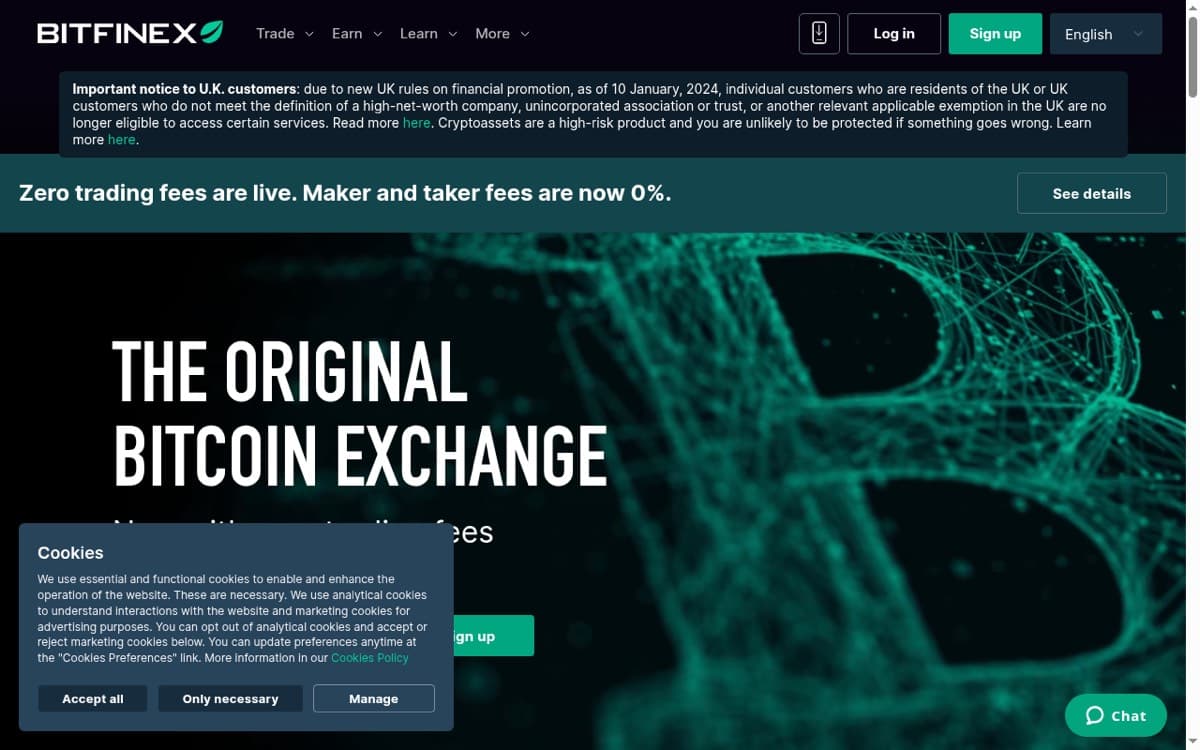
Bitfinex homepage and platform overview
Click to enlarge
Bitfinex markets and available trading pairs
Click to enlarge
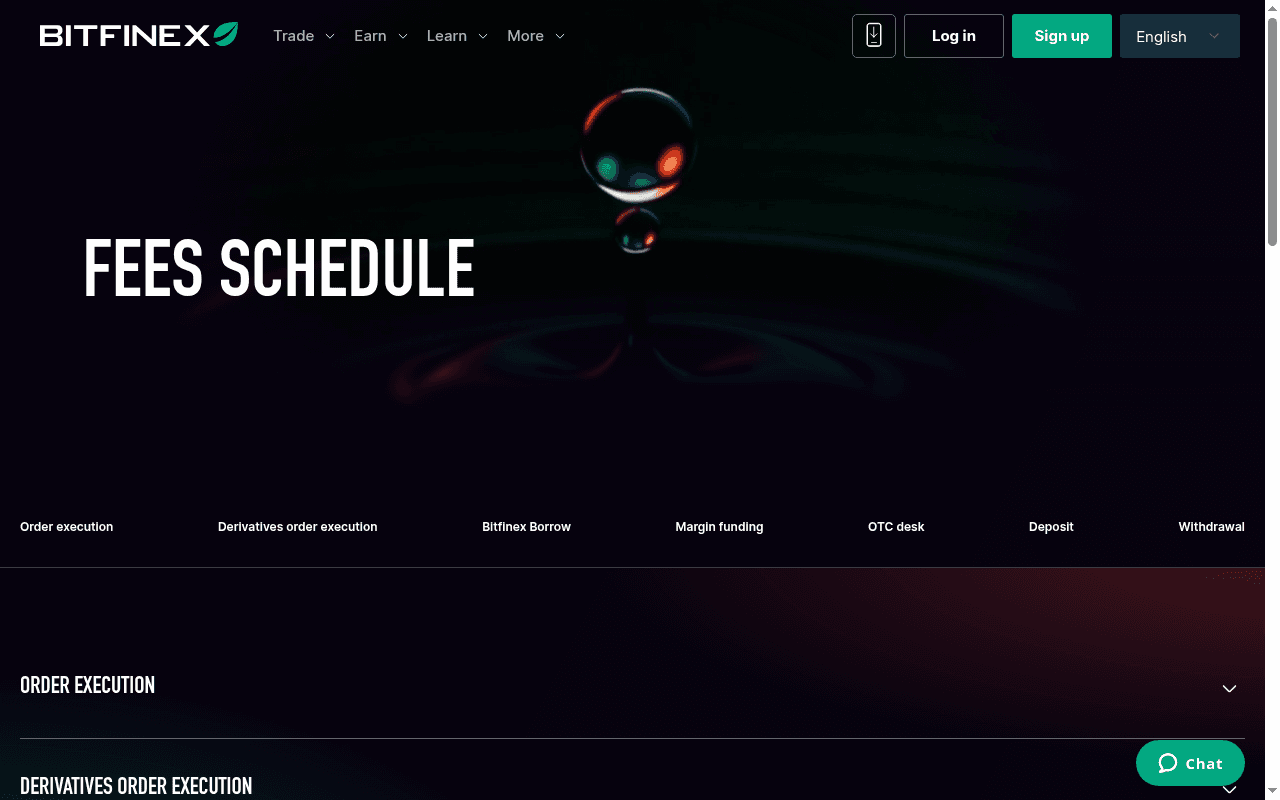
Bitfinex fee structure and trading costs
Click to enlarge
Frequently Asked Questions
Bitfinex changed its security controls after the 2016 hack. It states that it uses cold storage, mandatory 2FA, U2F keys, a withdrawal whitelist, and anti-phishing codes. BFX token redemption compensated affected users. The iFinex and Tether relationship remains a material risk. Bitfinex does not state deposit insurance. Check current custody terms before you deposit funds.
Bitfinex stopped serving U.S. residents in 2017. Using a VPN can violate its terms and risk account restrictions. Check its current eligibility rules. U.S. residents can compare locally available regulated services before they trade.
Bitfinex and Tether (USDT) are both owned by iFinex Inc. This is the single most important fact about Bitfinex. The NYAG documented that Tether reserves were used to cover an $850 million shortfall at Bitfinex related to funds seized from payment processor Crypto Capital. iFinex paid $18.5 million in 2021 to settle without admitting wrongdoing. The concern is simple: if Tether faces a confidence crisis or regulatory enforcement, Bitfinex is exposed through the shared corporate structure. Tether publishes quarterly attestations but has never completed a full independent audit. If this relationship concerns you, Kraken is the closest professional-grade alternative with zero stablecoin affiliations.
LEO is Bitfinex's native token, issued in 2019 to raise $1 billion after funds were seized from their payment processor Crypto Capital. It gives tiered fee discounts: 5% at 5,000 LEO, 10% at 10,000, 15% at 50,000, and 25% at 100,000+. The math only works if you trade enough volume for the savings to justify the capital locked in LEO. At 5,000 LEO (roughly $30,000), the 5% discount on a 0.1% maker fee saves $50/month on $1M volume. That is a 50-month breakeven, not accounting for LEO price fluctuations. LEO value is tied directly to Bitfinex's success and carries platform-specific risk. If Bitfinex faces regulatory action, LEO could lose significant value. Treat it as a utility tool, not an investment.
The P2P lending market lets users lend crypto to margin traders. You set an interest rate and loan duration. Rates change with demand. Your funds remain on Bitfinex during the loan. This creates counterparty risk. Check current rates, loan terms, and risk disclosures before you lend.
Bitfinex requires $10,000 minimum for all fiat deposits and withdrawals via bank wire. This applies to USD, EUR, GBP, and JPY. The 0.1% processing fee (minimum $20) on top of that makes the minimum effective cost about $20. Processing takes 5-10 business days depending on your bank and location. This high minimum is deliberate. Bitfinex wants professional and institutional accounts, not retail traders moving small amounts. If you have less than $10,000, you must deposit cryptocurrency instead, which has no minimum amount. For smaller accounts, Kraken accepts fiat deposits as low as $10 with faster processing, and Coinbase supports instant ACH deposits with no minimum.
Bitfinex provides iOS and Android apps with spot, margin, derivatives, and lending functions. The mobile interface has advanced controls. It supports 2FA, biometric login, and withdrawal whitelisting. Store ratings and features can change. Test the app before you rely on it.
Full KYC is required for most Bitfinex functions. It can require a photo ID, selfie, proof of address, and personal information. Higher limits can need more documents. Fiat access and crypto functions can be limited without KYC. Check current verification requirements before you submit documents.
Bitfinex has no simplified trading view or guided first-trade flow. It uses advanced charts, order books, and order forms. Margin and derivatives can create large losses. Learn the controls before you trade. Compare locally available services as well.
Customer support is a weakness. Bitfinex offers email ticket support only — no live chat, no phone support. Reported response times are slow: simple account questions around 36 hours, fee inquiries about 3 days, and verification questions over 5 days. Compare that to Kraken, which typically responds same-day, or Coinbase, which often replies within hours. Answer quality is competent when it arrives, but the wait times are a problem when you have an urgent account issue. Bitfinex posts announcements on Twitter/X but that is not a support channel. If fast customer service matters to you, this is a real drawback. For a platform handling the volume Bitfinex does, the lack of real-time support options is hard to justify.
Bitfinex and Kraken offer different order types, fees, and lending products. Bitfinex lists hidden, iceberg, and scaled orders. Kraken has different regulatory registrations and U.S. access. Compare current order books, fees, custody terms, and local product access before you choose.

Open Bitfinex provider page
No deposit required to explore
Bitfinex offer details
Check current terms, eligibility, and availability before you use an offer.
Bitfinex alternatives
Compare products in the same category and open each full review.
You Might Also Need


Related Exchanges


Related Guides
Cheapest Crypto Exchange: Compare the Full Cost
Open the full guide and view its current editorial status.
Is Binance Safe for US Users?
Open the full guide and view its current editorial status.
Crypto Futures Fees: Compare Costs, Margin, and Access
Open the full guide and view its current editorial status.
When to skip Bitfinex
Skip Bitfinex if you need protections that its current license or custody terms do not provide.
Sources & References
Market Data
User Reviews
Documentation
External links open in a new tab. We are not responsible for third-party content.
Risk Disclaimer
Cryptocurrency trading and investing involve a substantial risk of loss. Prices can change significantly in a short period, and you can lose some or all of your invested capital. This page gives information and does not give financial, investment, or legal advice. Check current provider terms and assess your risk before you make a financial decision. InsideCryptoReview can earn a commission from an affiliate link. A provider cannot approve or change our editorial copy. Past performance does not guarantee future results. Invest only an amount that you can afford to lose.