
Binance Review
Editorial record: June 1, 2026
Trading Fees
0.1% / 0.1%
Cryptocurrencies
490+
Founded
2017
Source status
Sources linked
No provider on this page operates or endorses InsideCryptoReview. Some links are affiliate links. We can earn a commission if you use them. A provider cannot approve or change editorial copy before publication. Read our editorial policy.
Risk Disclaimer
Cryptocurrency trading and investing involve a substantial risk of loss. Prices can change significantly in a short period, and you can lose some or all of your invested capital. This page gives information and does not give financial, investment, or legal advice. Check current provider terms and assess your risk before you make a financial decision. InsideCryptoReview can earn a commission from an affiliate link. A provider cannot approve or change our editorial copy. Past performance does not guarantee future results. Invest only an amount that you can afford to lose.
Editorial desk producing public-source crypto product research. Pages identify their evidence and limitations; hands-on testing is claimed only when dated evidence is shown.
Last Updated: June 1, 2026
Editorial MethodBinance offers spot markets, derivatives, and other crypto products. Its published base spot fees start at 0.10%. It also states that it maintains a SAFU fund. Binance paid a $4.3 billion U.S. Department of Justice settlement in 2023. Founder Changpeng Zhao later served four months in custody. Check current fees, product access, custody terms, and regulation in your location before you open an account.
Our Editorial Verdict
Binance combines spot markets, derivatives, P2P trading, and yield products. Its product range can make the interface difficult for new users. Complex support requests can also take time. Regional access and product availability vary.
May suit: Users who understand exchange custody and want to compare Binance's products, fees, and available markets.
Consider another exchange if: Binance is unavailable where you live, you need a simpler purchase flow, or you need stronger local regulatory protection.
Binance exchange overview
Changpeng Zhao launched Binance in July 2017. Binance offers spot markets, derivatives, and other crypto products. CoinGecko publishes exchange volume data. Check the current data before you rely on a volume comparison.
What to check
- The current fee schedule for your market and product
- The order-book depth and estimated execution price for your order size
- Which products are available in your country
- The custody and fund-protection terms that apply to your account
Compare the final quote, spread, and withdrawal fee before you trade. Published base fees do not show all execution costs.
Order-book depth is a key factor for larger trades. On major BTC/USDT markets, limit orders can fill near the quoted price in normal conditions. On thinner markets, the same order can add 0.1–0.3% in slippage.
More than a trading venue
Binance offers services beyond its order book:
- BNB Chain reports low network fees for many transactions. An Ethereum mainnet swap can cost more during congestion. Check the current fee before you transact.
- Launchpad has run token sales since 2019, including Polygon (MATIC), Axie Infinity (AXS), and The Sandbox (SAND). Allocation depends on average BNB held during a snapshot window.
- Binance Card spends crypto at 60M+ merchants with point-of-sale conversion and tiered BNB cashback.
- Binance Academy is a free, genuinely substantive education library.
Skip Binance if any of these apply to you:
- You are a US resident — Binance.com is unavailable. Binance.US is a separate service with different products and liquidity.
- You want a simple buy-and-hold flow — the interface includes futures, margin, and earn products. New users may prefer a service with fewer product types.
- Custody and regulatory risk concern you — Binance settled with the U.S. Department of Justice in 2023. Some users keep long-term assets in self-custody or use a locally regulated service.
Binance fees and charges
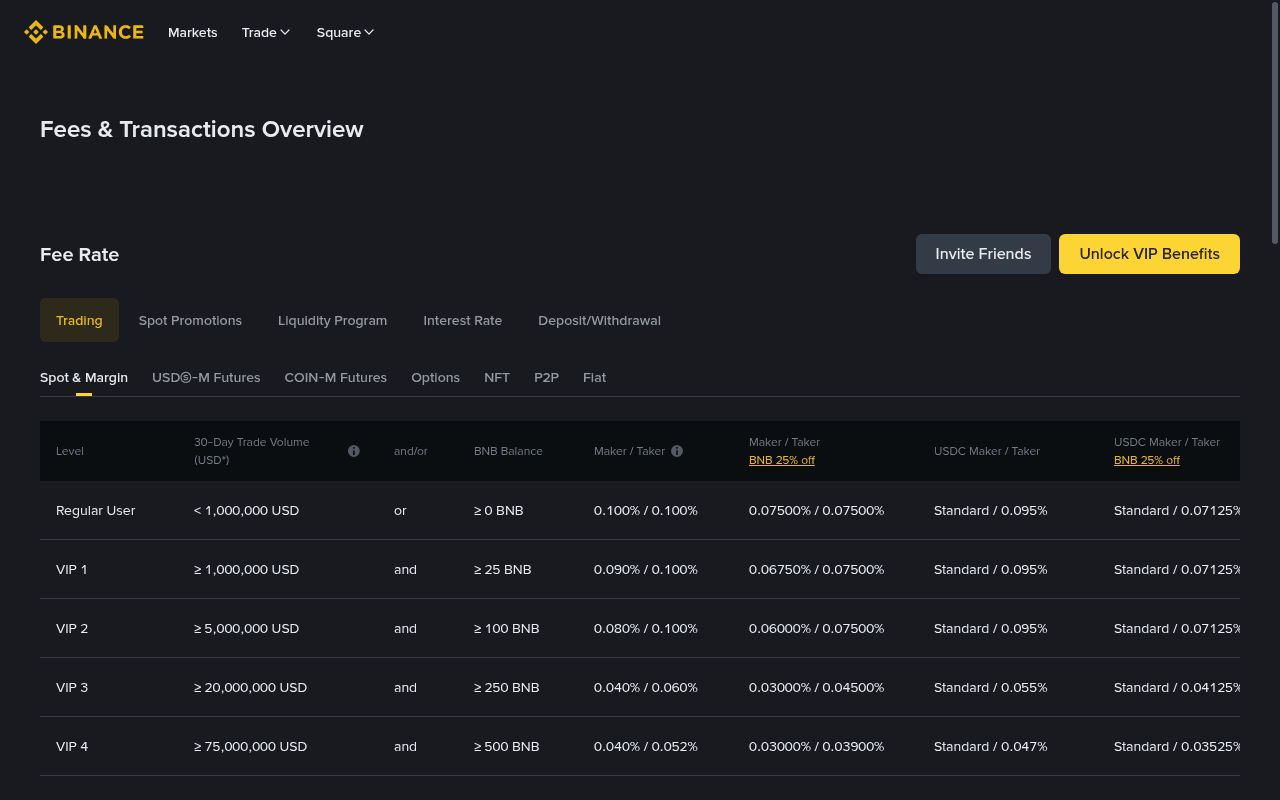
Binance publishes separate fee schedules for spot, derivatives, payment methods, and withdrawals. Check the schedule that applies to your account before you trade.
Spot Trading Fees
Binance lists a 0.10% base maker and taker rate for eligible spot orders. Its fee schedule may offer a BNB payment discount. Check the current rate and eligibility conditions.
Published base-fee comparison:
| Exchange | Maker Fee | Taker Fee | Notes |
|---|---|---|---|
| Binance | 0.10% | 0.10% | 0.075% with BNB |
| Coinbase | 0.40% | 0.60% | Check the current tier |
| Kraken | 0.25% | 0.40% | Pro tier required |
| Bybit | 0.10% | 0.10% | Similar to Binance |
| OKX | 0.08% | 0.10% | Slightly cheaper maker |
On a $10,000 order, a 0.075% fee is $7.50 and a 0.60% fee is $60. Spreads, order execution, and withdrawal costs can change the total cost.
Futures Fees
Futures start at 0.02% maker and 0.05% taker. BNB discounts and VIP tiers can lower the published rate. Check the schedule for your tier.
The VIP Tier Breakdown
| VIP Level | 30-Day Volume | BNB Required | Maker | Taker |
|---|---|---|---|---|
| Regular | Under $1M | None | 0.100% | 0.100% |
| VIP 1 | $1M+ | 25 BNB | 0.090% | 0.100% |
| VIP 2 | $5M+ | 100 BNB | 0.080% | 0.090% |
| VIP 3 | $10M+ | 250 BNB | 0.070% | 0.080% |
| VIP 4 | $25M+ | 500 BNB | 0.060% | 0.070% |
| VIP 5 | $50M+ | 1,000 BNB | 0.050% | 0.060% |
| VIP 6 | $100M+ | 1,750 BNB | 0.040% | 0.050% |
| VIP 7 | $250M+ | 3,000 BNB | 0.030% | 0.040% |
| VIP 8 | $500M+ | 4,500 BNB | 0.025% | 0.031% |
| VIP 9 | $1B+ | 5,500 BNB | 0.020% | 0.024% |
VIP thresholds depend on 30-day volume and BNB holdings. Some higher tiers include an account manager. Check the current program terms.
Deposit and Withdrawal Costs
Crypto deposits are always free. That matters because some exchanges sneak in deposit fees. Withdrawal fees depend on the network, and this is where paying attention saves money.
USDT via TRC-20 (Tron) costs $1.00. The exact same USDT via ERC-20 (Ethereum) costs $3.50. Same token, same destination, 3.5x the cost. Always check which network you are using.
BTC withdrawal costs 0.0002 BTC (about $12-15 at current prices). ETH costs 0.00052 ETH. SEPA bank transfers to European accounts are free. Credit card deposits carry a 1.8% surcharge, and this is where Binance quietly gets expensive.
Hidden Costs Worth Knowing
The "Buy Crypto" flow can include a 0.5–2% spread versus the spot interface. On a $500 ETH purchase, that can add about $2.50–$10. Compare the final quote with a spot order. Binance's fee schedule lists spot tiers.
The Convert feature has a similar problem. It looks like a free swap between coins, but there is a 0.1-0.5% spread hidden in the exchange rate. For small amounts it does not matter. For $5,000+ swaps, use the spot market.
Futures funding rates are another cost to check. Perpetual contracts charge or pay funding every eight hours. Published rates can reach 0.1% per period in volatile markets. A leveraged position can incur substantial funding costs.
One positive: Binance does not charge inactivity fees. Your account can sit dormant for years and they will not touch your balance. Coinbase does the same, but some smaller exchanges do charge for inactive accounts.
Is Binance Safe? Security Analysis
Binance states that it uses a SAFU fund, cold storage, and account security controls. These controls do not remove market, custody, or regulatory risk.
The SAFU Fund
SAFU stands for Secure Asset Fund for Users. Binance states that it holds $1 billion in USDC stablecoins and receives 10% of trading-fee revenue. Check the current fund details and terms before you rely on it.
In May 2019, hackers exploited API keys and 2FA codes to steal 7,000 BTC. Binance stated that SAFU covered affected users. Past reimbursement does not guarantee future coverage.
Binance publishes a SAFU wallet address. A public wallet balance does not establish the scope or terms of user protection.
Cold Storage and Key Management
Binance stores approximately 95% of user assets in air-gapped cold wallets. These wallets are physically disconnected from the internet and distributed across multiple geographic locations. Withdrawals from cold storage require multi-signature authorization from several team members.
The remaining 5% sits in hot wallets to handle day-to-day withdrawals. That is standard for exchanges of this size. It would be impractical to keep everything in cold storage when you are processing billions in daily withdrawals.
Account Security Features
The withdrawal-address whitelist limits withdrawals to approved addresses. Binance states that adding an address triggers a 24-hour waiting period. Enable it if the feature is available to your account.
An anti-phishing code appears in legitimate Binance emails. Set a unique code. Treat an email without the code as suspicious.
Hardware 2FA (YubiKey) is stronger than Google Authenticator or SMS. SMS-based 2FA is vulnerable to SIM swap attacks. Google Authenticator is better but still tied to your phone. A hardware key is the gold standard.
Proof of Reserves: Trust but Verify
After FTX collapsed in November 2022, exchanges expanded proof-of-reserves disclosures. Binance uses zk-SNARKs in its Proof of Reserves program. This is a form of zero-knowledge cryptography.
You can check whether your account balance is included in Binance's reported reserves. Binance also publishes wallet addresses. A snapshot has limits, including possible temporary borrowing. Read the methodology before you rely on it.
Threat Detection by the Numbers
Binance reported security controls for suspected fraud in 2024. Check Binance's current security report for its method and scope.
The Hack History and What Changed
Binance reports more than 1,000 security and compliance staff. It also reports audits and real-time monitoring. Review each provider's current scope before you rely on it.
Account-security actions
Use hardware 2FA where available. Set a withdrawal whitelist and anti-phishing code. Review active devices and revoke unfamiliar sessions.
Trading Features & Products
Binance lists spot trading, derivatives, margin trading, P2P trading, and yield products. Product access changes by region.
Spot Trading
490+ cryptocurrencies across 1,889 trading pairs. That is more than Coinbase (200+), Kraken (200+), and roughly tied with Bybit (400+). Binance also lists new tokens faster than most competitors. When a trending coin gains momentum, Binance usually has it within weeks.
Order types include Market, Limit, Stop-Limit, OCO (One Cancels the Other), and Trailing Stop. OCO orders let traders set a take-profit and a stop-loss simultaneously — whichever triggers first automatically cancels the other. Not every exchange offers this.
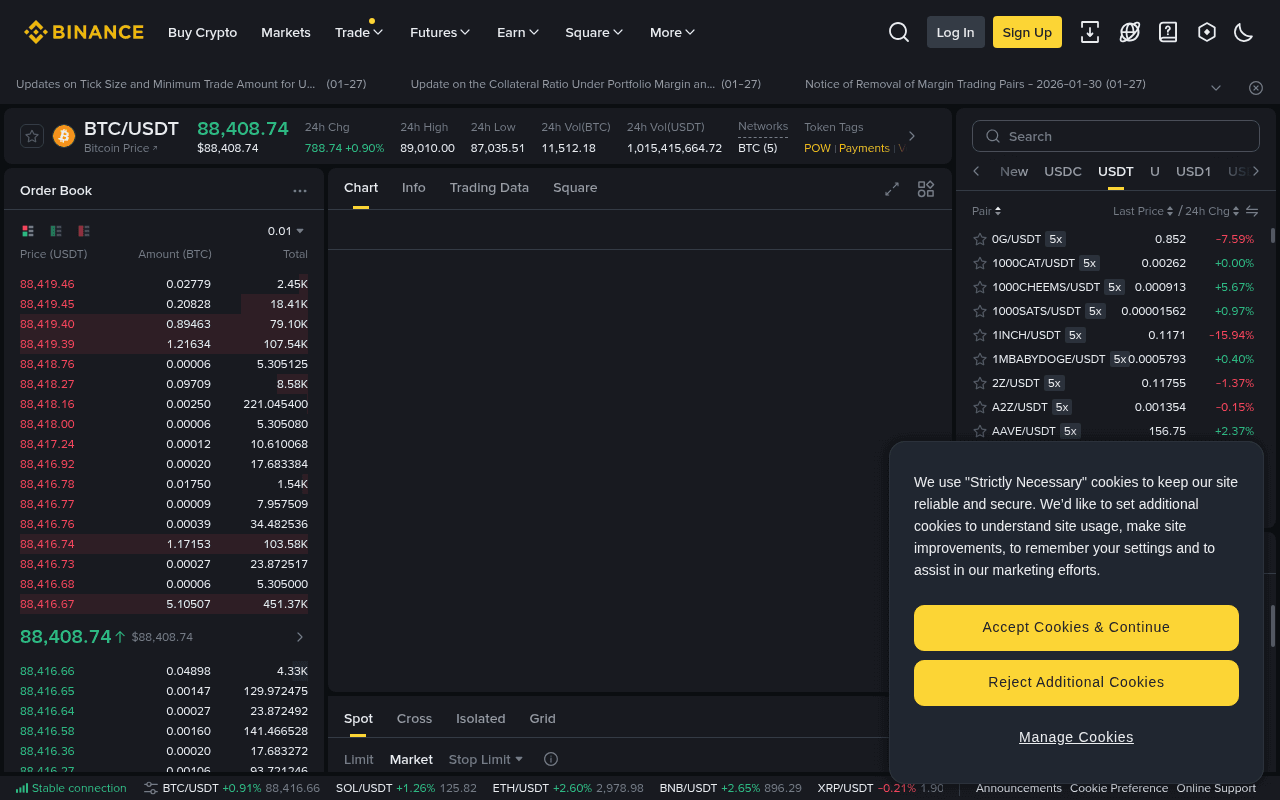
There are two interfaces: Lite Mode for beginners and Pro Mode for experienced traders. Lite Mode strips everything down to a simple buy/sell screen. Pro Mode gives you the full TradingView charting suite, order book depth, and trade history. Starting in Lite and switching to Pro once comfortable is the path most new users take.
Futures Trading: Powerful but Dangerous
Binance offers USD-M and COIN-M futures where available. Check the current contract list and product terms.
The maximum leverage can reach 125x on selected pairs. A 0.8% move against a 125x position can trigger liquidation. Read the margin, funding, and liquidation terms before you open a position.
Futures fees start at 0.02% maker and 0.05% taker, which are genuinely low. With BNB payment and volume discounts, active traders can push maker fees to zero.
Margin Trading
Up to 10x on isolated margin, with cross-margin available for those who understand the risk difference. You can borrow BTC, ETH, USDT, and 50+ other assets. Interest rates start from 0.00014629% per hour, though rates fluctuate based on supply and demand.
Isolated margin means each position has its own margin. If you get liquidated, you only lose the margin allocated to that position. Cross-margin uses your entire account balance as collateral. More capital efficient, but one bad trade can damage everything.
P2P Trading
P2P trading connects buyers and sellers who use local payment methods. Available methods can include bank transfers, mobile money, PayPal, Revolut, and cash.
Binance states that it holds the seller's crypto in escrow until payment is confirmed. Check a counterparty's completion rate, trade count, and payment instructions before you pay.
Binance publishes zero platform fees for P2P trades. A seller can still set a price above the spot market. Compare the quote with your total card and transfer costs.
Copy Trading
Binance added copy trading in 2023 and it has grown quickly. You can follow profitable traders and automatically mirror their positions. Performance statistics are transparent: you can see their win rate, total PnL, drawdown, and how many copiers they have.
Copy trading mirrors a lead trader's positions in proportion to your allocation. A lead trader's liquidation can also liquidate your copied position. Review maximum drawdown, open positions, and history. A short history can exclude traders who already stopped trading.
Binance Earn
Flexible Savings lets you deposit crypto and earn interest while keeping the ability to withdraw anytime. Stablecoin APY typically runs 2-5%. Locked Savings offers 5-15% APY if you commit funds for 30, 60, 90, or 120 days.
Staking supports selected proof-of-stake coins. Launchpool can allocate newly listed tokens to users who stake BNB or stablecoins. Check lock-up terms, eligibility, and token risk before you participate.
Launchpad: Early Token Access
Binance Launchpad has facilitated 80+ token sales since January 2019. Some have been massive winners: Polygon (MATIC) returned over 1,000x from launch to all-time high. Axie Infinity (AXS) exploded during the 2021 gaming boom. BitTorrent (BTT) peaked at 59.8x the ICO price.
Some launch tokens trade below their initial price within weeks. Allocation depends on average BNB holdings during a snapshot period. Read the token documents and risk disclosures before you subscribe.
Other Products Worth Mentioning
Binance NFT Marketplace, Web3 Wallet, Binance Card, and Binance Pay round out the ecosystem. The Web3 Wallet is particularly useful for interacting with DeFi on BNB Chain without leaving the Binance app. Options trading (European-style, BTC and ETH) is available but with less liquidity than you would find on Deribit.
Binance Mobile App Review
The Binance mobile app is available on iOS and Android. See its current App Store and Google Play listings. Ratings and review counts vary by storefront and date.
Lite Mode vs Pro Mode
Lite Mode has a simple buy and sell screen. Pro Mode has TradingView charts, depth charts, an order book, technical indicators, and more order controls.
Pro Mode can suit users who place limit orders or read charts. Lite Mode reduces a purchase to a few steps. Both modes use the same account balance.
What Works Well
Binance offers price and order-fill notifications. Test the notifications on your device before you rely on them.
The app supports biometric login on compatible devices. It also offers a home-screen price widget.
The mobile app provides access to spot trading, futures, margin, P2P, Binance Earn, and Launchpool where available. The futures screen shows order controls and real-time PnL.
What Could Be Better
The app contains many screens and menus. The home screen promotes Binance products and campaigns. Users cannot remove every home-screen item.
During high volatility, order-book and chart data can lag. Check order status directly before you assume an order failed.
Some features sit in sub-menus. The withdrawal whitelist is in the security settings. The spot trading interface is under the Trade tab.
Battery and Performance
Battery use depends on the device and settings. Charts can lag on older phones. Test alerts on your device before you rely on them.
Bottom Line
The Binance app gives eligible users access to spot, futures, margin, P2P, Earn, Launchpool, and a Web3 wallet. Product access varies by location. Lite and Pro modes use the same account.
Customer Support: The Weak Point
Trustpilot lists Binance at 1.6/5 from more than 5,200 reviews. Read recent reviews and Binance's support terms before you depend on a response time.
What is available
Live Chat runs 24/7 and starts with an AI chatbot. It can direct routine questions to help articles. Account-specific cases can require a human agent.
The Ticket System handles complex issues. Public reviews report 18–72 hour waits for some non-urgent cases. These reports do not predict the response time for your case.
The Help Center has guides for KYC, deposits, withdrawals, and API keys. Check it before you open a support case.
What the review record consistently shows
Three patterns recur across public complaints and Binance's own help documentation:
- Routine questions (email/settings changes, fee lookups) are handled fast by the chatbot — minutes, not hours.
- Stuck deposits/withdrawals are the worst experience: queue waits, then a human who can often only confirm "pending," with resolution measured in many hours.
- Security events (suspicious login, unauthorized access) are escalated and prioritized — the one category where Binance support reliably responds quickly, because the liability is theirs.
The real problem
Support demand can rise during market shocks and major news events. Public reviews describe longer live-chat waits and 48–72 hour ticket times during some periods.
The chatbot can answer routine questions. Stuck withdrawals, account freezes, and verification issues can require a human investigation.
VIP users (VIP 3 and above) get dedicated account managers with direct communication channels. If you trade enough volume to qualify, support improves dramatically. But most retail users will not reach that tier.
Support tips
Start with the Help Center. Include a transaction ID, screenshots, and a clear description when you contact support. State the network, amount, and time of the transaction.
Use the Security category for suspected account compromise or unauthorized trades. Follow Binance's current official contact guidance for urgent cases.
The Honest Verdict
Support quality varies by issue and market conditions. Compare each service's current support options, fees, liquidity, and local regulatory status before you choose.
Binance vs Alternatives: How It Compares
This table compares published fees, product availability, and stated fund protections. Check current terms before you open an account.
| Feature | Binance | Coinbase | Kraken | OKX | Bybit |
|---|---|---|---|---|---|
| Base Fees | 0.10%/0.10% | 0.40%/0.60% | 0.25%/0.40% | 0.08%/0.10% | 0.10%/0.10% |
| Coins | 490+ | 200+ | 200+ | 350+ | 400+ |
| Futures | Yes, 125x max | Very limited | Yes, 50x max | Yes, 125x max | Yes, 100x max |
| US Access | No | Yes | Yes | No | No |
| Insurance | $1B SAFU | $255M policy | None disclosed | $430M reserve | None disclosed |
| Trustpilot | 1.6/5 | 1.8/5 | 1.5/5 | 1.9/5 | 1.8/5 |
| Main focus | Broad product range | U.S. access | Security-focused exchange | Web3 products | Derivatives |
Binance vs Coinbase: The Most Common Comparison
Binance.com is unavailable to U.S. residents. Binance.US is a separate service with different products. Compare U.S.-available exchanges and their current terms.
For everyone else: Binance charges 0.10% per trade versus Coinbase's 0.40-0.60%. That is 4-6x more expensive on Coinbase. On a $10,000 trade, you save $30-50 by using Binance. Binance lists 490+ coins versus Coinbase's 200+. Binance has full futures and options trading. Coinbase has almost none.
Where Coinbase wins: regulatory transparency (publicly listed on NASDAQ, audited financials), a genuinely simple interface for first-time buyers, and better customer support reputation. If you have never bought crypto before, Coinbase is easier. Once you know what you are doing, Binance costs less and does more.
Binance vs Kraken: Security vs Features
Kraken has never been hacked. That is a meaningful advantage. They are also available in the US and have a reputation for taking security seriously.
Binance has lower fees (0.10% vs 0.25-0.40%), more coins (490+ vs 200+), and a much larger ecosystem. Kraken's futures offering caps at 50x versus Binance's 125x. Kraken's interface is clean and well-designed but the product range is narrower.
Kraken may suit users in the United States or users who prefer a smaller product range. Compare its current security disclosures and product access.
Binance vs OKX: The Closest Competitor
OKX is the exchange that comes closest to matching Binance feature-for-feature. Maker fees are actually slightly lower on OKX (0.08% vs 0.10%). Both offer 125x futures. Both have large ecosystems.
Where Binance wins: liquidity (consistently 2-3x more daily volume than OKX), coin selection (490+ vs 350+), and P2P marketplace size. Where OKX wins: Web3 wallet integration is smoother, the trading interface feels more modern, and their DeFi aggregator is better.
Compare current order-book depth before you trade large orders. Binance and OKX also differ in wallet features and regional product access.
Binance vs Bybit: Derivatives Specialists
Bybit built its reputation on derivatives and it shows. Their perpetual futures interface is cleaner and more intuitive than Binance Futures. The mobile experience for derivatives trading is slightly better on Bybit.
But Binance beats Bybit on everything else: more spot pairs, larger ecosystem, P2P marketplace, Launchpad, Earn products, and the SAFU insurance fund. If you primarily trade perpetual futures and do not need the broader ecosystem, Bybit is worth considering. For everything else, Binance offers more under one roof.
How to Get Started with Binance
Binance publishes the following account-registration process. Completion time and requirements vary by region and account review.
Step 1: Register (2 Minutes)
Go to binance.com and click Register. Enter your email and a strong password. You will receive a verification code by email. Enter it. Done. You can also register with your phone number or an Apple/Google account if you prefer.
Step 2: Set Up Security Before Anything Else (3 Minutes)
Do this before depositing a single dollar. Go to Security Settings and enable 2FA. Google Authenticator is the minimum. A hardware key (YubiKey) is better. Avoid SMS-based 2FA if possible because of SIM swap risks.
While you are in the settings, create your anti-phishing code. Pick a memorable word or phrase. Every real Binance email will display this code. If you get a Binance email without it, it is phishing.
Step 3: Complete KYC (5-20 Minutes)
Click your profile icon, then Identification. You will need a government-issued ID (passport, driver's license, or national ID) and a selfie. The facial recognition verification takes about 30 seconds on a decent phone camera.
Binance states that KYC review times can vary. Withdrawal limits and fiat access depend on verification level and region. Check the current terms before you fund an account.
Step 4: Deposit Funds (1 Minute to 3 Days)
For crypto: Go to Wallet, then Deposit. Select your coin and double-check the network. Sending USDT on the wrong network means lost funds. TRC-20 is cheapest for USDT. BEP-20 (BNB Chain) is cheapest for most Binance-listed tokens.
For fiat: SEPA bank transfer is free and arrives in 1-3 business days for European users. Credit card is instant but costs 1.8%. Starting with a small test deposit ($50-100) to confirm the process before sending larger amounts is standard practice.
Step 5: Make Your First Trade (2 Minutes)
Here is the part most beginners get wrong. Do not use the "Buy Crypto" button on the homepage. It adds a 0.5-2% spread markup.
Instead, go to Trade, then Spot. Search for your pair (BTC/USDT, ETH/USDT, whatever you want). Place a Limit order at your desired price, or a Market order for instant execution. If you are buying $500 of BTC, a limit order at the current price saves you about $2-5 compared to the Buy Crypto button. That adds up.
First-Timer Checklist
Before your first real trade, make sure you have done all of these:
- 2FA enabled (Google Authenticator or hardware key)
- Anti-phishing code set
- BNB fee payment enabled (saves 25% on every trade)
- Withdrawal whitelist turned on (optional but strongly recommended)
- Started in Lite mode if the Pro interface looks intimidating
One more thing: buy a small amount of BNB and enable the "Pay fees with BNB" option in your settings. This gives you an automatic 25% discount on every spot trade. It costs nothing to set up and saves real money over time.
What Real Users Say
This section summarizes public reviews from Trustpilot, Reddit, and app stores. Individual reviews can be incomplete or unverified.
Trustpilot: 1.6/5 (5,200+ Reviews)
The Trustpilot score looks terrible and it needs context. People who have a bad experience with an exchange are 10x more likely to leave a review than satisfied users. Every major exchange has a bad Trustpilot score: Coinbase is 1.8/5, Kraken is 1.5/5, OKX is 1.9/5.
The most common positive reviews mention fast order execution and low fees. Multiple users specifically call out the BNB fee discount as a reason they prefer Binance over Coinbase.
Public reviews mention account freezes during KYC reviews and withdrawals that need manual review. Some reviews also report slow support responses. Check the current support terms before you depend on a response time.
App Store: 4.5/5 iOS, 4.4/5 Android
The app store reviews paint a very different picture from Trustpilot. Over 3 million combined reviews with a 4.4+ average. Users praise the range of features, the Lite/Pro mode toggle, and the charting tools.
Common complaints in app reviews: occasional crashes during high volatility, the interface being too crowded for beginners, and notification overload from promotional campaigns. Several users mention that the app improved significantly with recent updates that streamlined the navigation.
Reddit: Mixed But Informative
The r/binance subreddit (650K members) is a mix of support requests, trading discussions, and occasional complaints. The r/cryptocurrency subreddit is harder on Binance, partly because of the 2023 DOJ settlement.
Active traders on Reddit tend to defend Binance on fees and liquidity while acknowledging the support problems. A recurring theme is that Binance works great until something goes wrong, and then you are on your own for a while before getting help.
One Reddit user wrote that Binance has a broad selection but can be difficult to contact for support. Treat this as an individual opinion.
Regulation & Legal Status
Binance's regulatory history includes a 2023 U.S. settlement. Regional licensing, account access, and product availability can change.
The $4.3 Billion Fine: What Actually Happened
In November 2023, Binance agreed to pay $4.3 billion to settle charges from three U.S. government agencies: the Department of Justice (DOJ), the Financial Crimes Enforcement Network (FinCEN), and the Office of Foreign Assets Control (OFAC).
The core issue: Binance failed to implement adequate anti-money laundering controls and processed transactions that violated U.S. sanctions. They allowed users in sanctioned countries to trade on the platform without proper restrictions.
CZ (Changpeng Zhao) stepped down as CEO as part of the deal. He later served a 4-month prison sentence, which he completed in 2024. He remains a shareholder but has no operational role.
To put the fine in context: $4.3 billion is the largest corporate penalty in financial crime history. It is also roughly one quarter of Binance's estimated annual revenue. The company paid it and kept operating without missing a beat. That says something about how profitable the exchange is.
The New CEO: A Regulator Running the Exchange
Richard Teng replaced CZ in November 2023. Teng was CEO of the Financial Services Regulatory Authority at Abu Dhabi Global Market. He also held senior roles at the Monetary Authority of Singapore and Singapore Exchange.
Binance reports that Teng expanded its compliance team to more than 1,000 employees. It also reports hiring former regulators and increasing regulatory cooperation.
Published registrations and licenses
| Country | Regulator | License Type |
|---|---|---|
| France | AMF | DASP Registration |
| Italy | OAM | Crypto Asset Registration |
| Spain | Bank of Spain | VASP Registration |
| Poland | Tax Chamber | VASP Registration |
| Abu Dhabi | ADGM | Full FSP License (3 licenses, Dec 2025) |
| Lithuania | FNTT | VASP License |
| Sweden | FSA | Registration |
| Kazakhstan | AIFC | Full License |
Check the relevant regulator register and Binance's current legal disclosures before you rely on a listed registration or license.
The Full Timeline
Binance's regulatory history is one of the most heavily documented in crypto, culminating in the November 2023 U.S. Department of Justice settlement. Here is how it unfolded:
2017-2019: Binance operated with minimal oversight, moving headquarters from China to Japan to Malta to the Cayman Islands. Regulators were mostly ignoring crypto at this point.
2019: Japan's FSA and UK's FCA issued the first significant warnings about Binance operating without proper licenses.
2021: The UK's FCA banned Binance from offering regulated services to British consumers. Binance pulled out of Ontario, Canada. This was the year regulators worldwide started paying attention to crypto exchanges.
2022: Binance obtained its first major EU registration in France, followed by Italy and Spain. The compliance push had started.
2023: The $4.3 billion settlement. CZ resigned. Richard Teng took over. This was the turning point.
2024: CZ completed his prison sentence. Binance hired aggressively in compliance, adding 1,000+ employees focused on AML, KYC, and regulatory affairs.
2025: The SEC dropped several charges against Binance in early 2025. ADGM granted three licenses in December.
Binance states that it operates under multi-year DOJ and FinCEN monitoring. Confirm the current status in official records.
What This Actually Means for Your Money
The settlement and monitoring describe regulatory oversight. They do not guarantee protection from custody, service-access, or market risk. Regulatory action in a user's country can restrict account access or services. Review the legal terms and regulator records that apply to your location.
Pros & Cons
What We Like
- Spot fees start at 0.1% maker/taker, dropping to 0.075% with the BNB discount
- 490+ coins and 1,889 trading pairs make it the widest selection of any exchange
- Deepest liquidity in crypto with $34 trillion in 2026 volume and roughly 40% market share
- Full product suite: spot, margin (up to 10x), futures (up to 125x), options, and copy trading
- $1 billion SAFU insurance fund plus on-chain Proof of Reserves you can verify yourself
- Massive ecosystem beyond trading: Binance Earn, Launchpad, NFT marketplace, Web3 wallet, and Binance Card
- API handles 1.4 million orders per second, built for algorithmic and high-frequency strategies
- P2P marketplace covers 300+ payment methods in 100+ fiat currencies with zero platform fees
What Could Be Better
- Completely blocked for US residents; Binance.US is a stripped-down separate entity with 150 coins and no futures
- The Pro trading interface is genuinely overwhelming for anyone who has never used an exchange before
- Customer support scores 1.6 out of 5 on Trustpilot; complex issues can take 18+ hours to resolve
- Paid a $4.3 billion fine to the DOJ in 2023 over AML and sanctions violations; founder CZ served prison time
- Certain features are geo-restricted depending on your country, and these restrictions shift without much warning
- Futures at 125x and margin at 10x can wipe accounts fast; most retail traders lose money on leveraged products
- Full KYC is mandatory for fiat access and reasonable withdrawal limits; without it you are capped at 0.06 BTC per day
What to check
This profile summarizes public-source information. Check the linked evidence for each factor before you decide.
- Trading Fees
- Security
- User Experience
- Customer Support
Binance vs Exchanges
| Feature |  |  |  |  |
|---|---|---|---|---|
| Trading Fees | 0.1% / 0.1% | 0.1% / 0.1% | 0.2% / 0.2% | 0.1% / 0.1% |
| Cryptocurrencies | 490+ | 700+ | 200+ | 800+ |
| Security | 2FA available | 2FA available | 2FA available | 2FA available |
| Read Review → | Read Review → | Read Review → | Read Review → |
Binance Screenshots & Interface
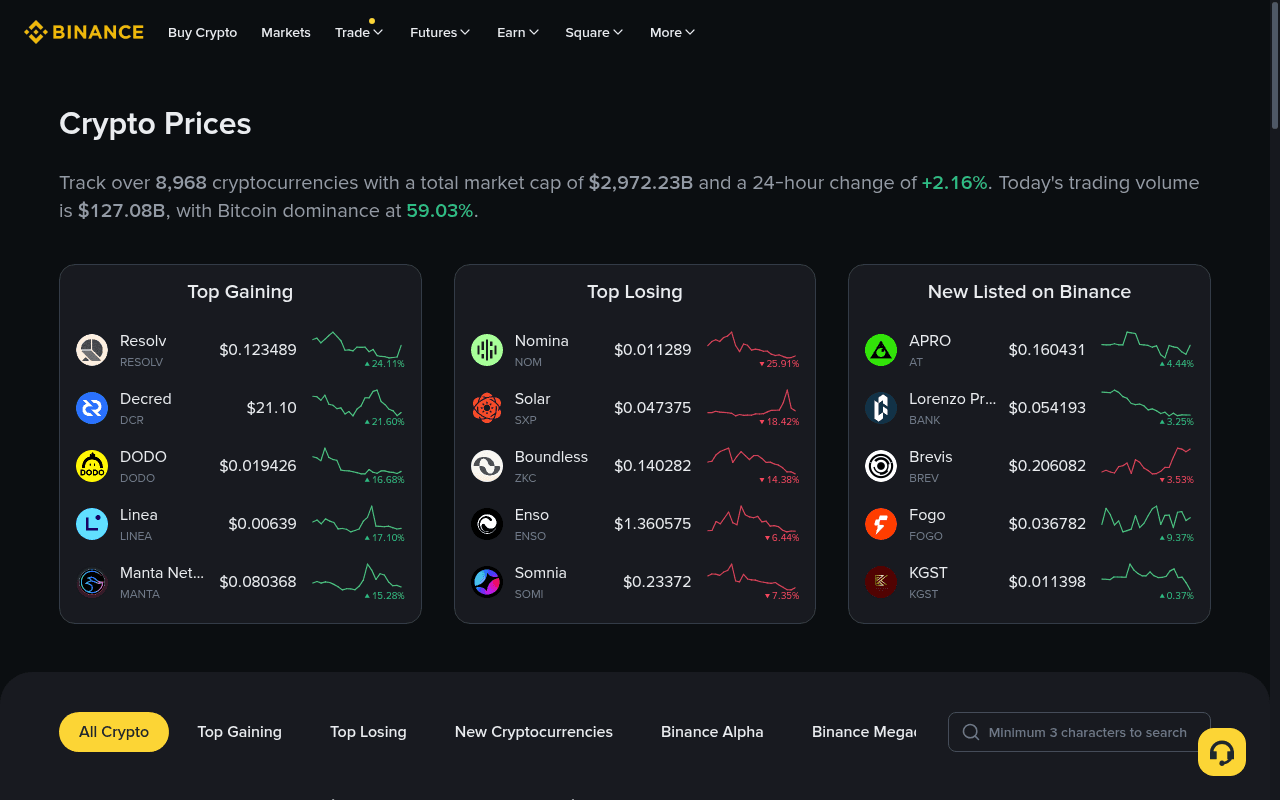
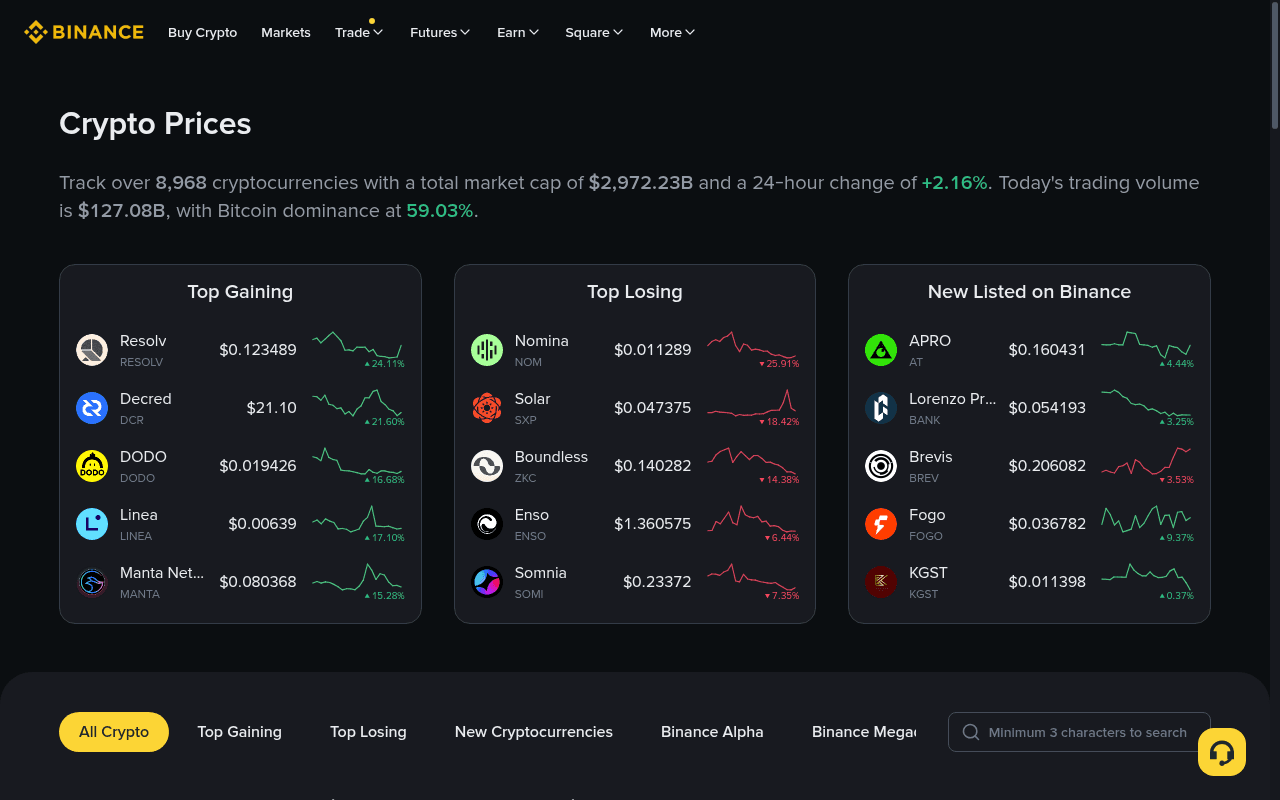
Real-time cryptocurrency prices with market cap and 24h changes
Click to enlarge
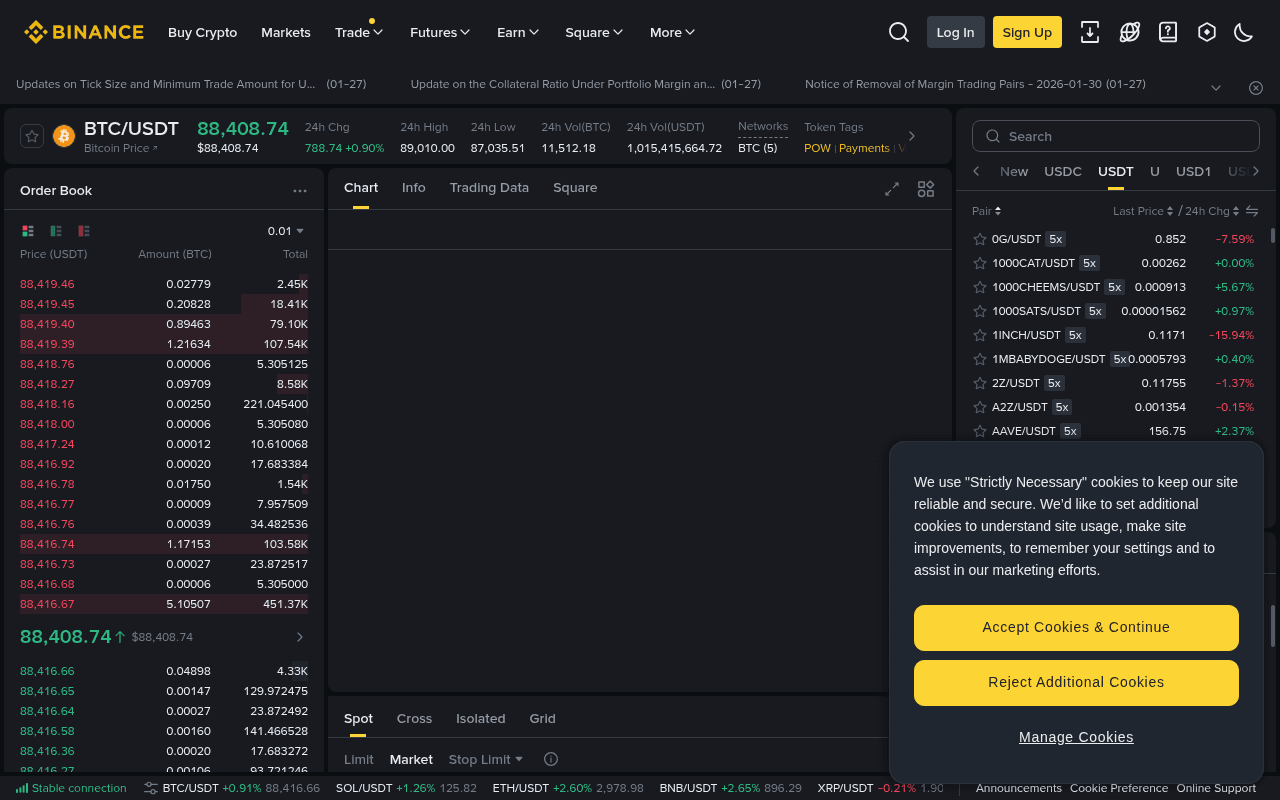
Professional trading interface with advanced charting tools
Click to enlarge
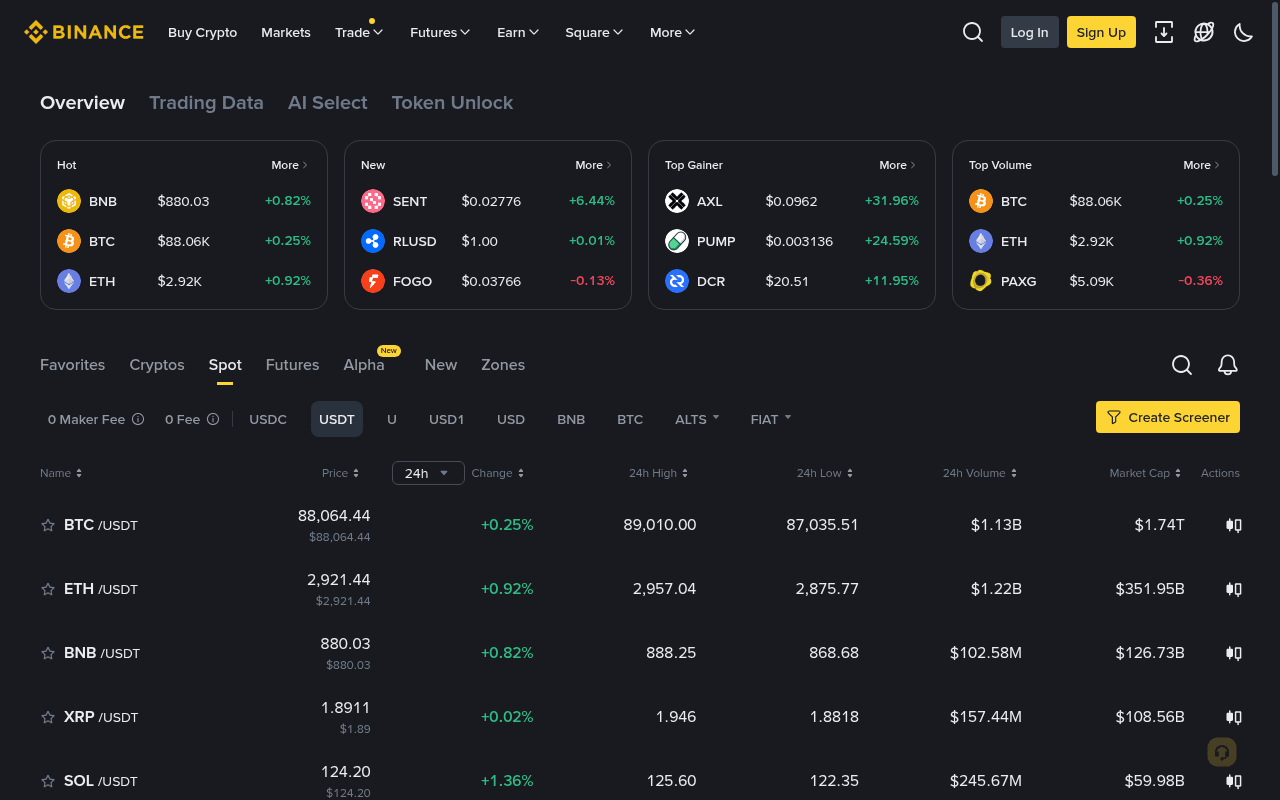
Complete overview of all available trading pairs and market data
Click to enlarge
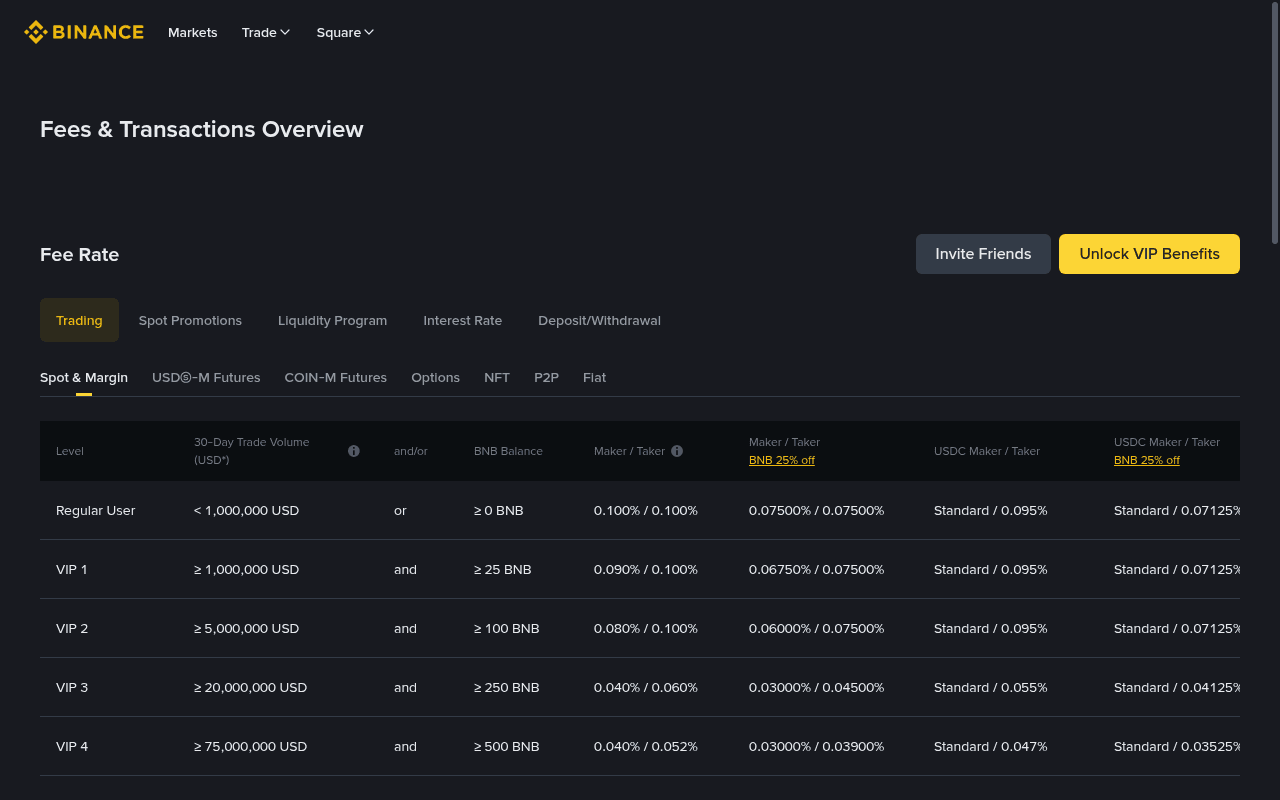
Transparent fee structure with VIP discounts
Click to enlarge
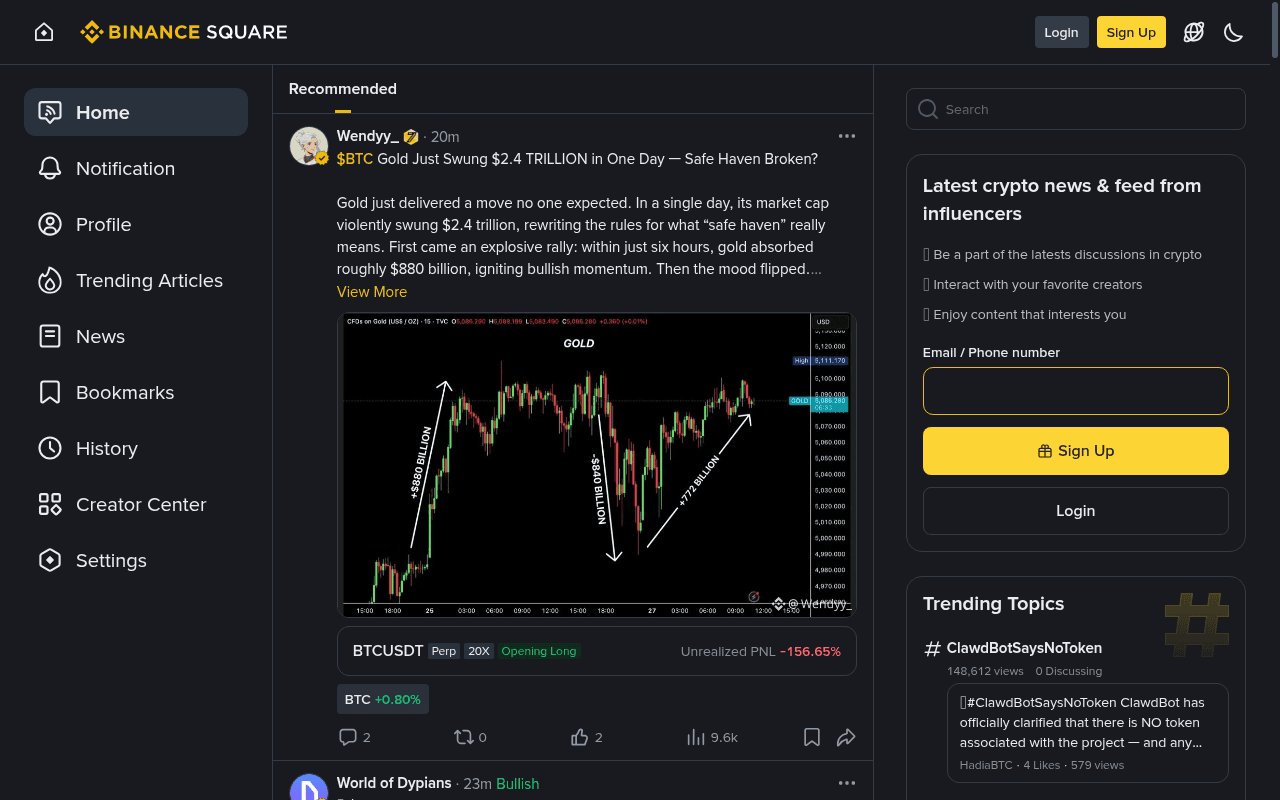
Social feed with crypto news, analysis and community insights
Click to enlarge
Frequently Asked Questions
Binance states that it maintains a SAFU fund, uses cold storage, and offers proof-of-reserves information. It also settled with U.S. agencies in 2023 and states that it operates under monitoring. These measures do not remove custody, market, or regional service-access risk. Review the current account terms and legal status in your location before you deposit funds.
Binance lists a 0.10% base maker and taker rate for eligible spot orders. It lists different fees for derivatives and volume tiers. BNB payment can change an eligible fee. Compare the current fee schedule, final quote, spread, and withdrawal fee before you trade.
Binance.com is unavailable to U.S. residents. Binance.US is a separate legal entity with different assets and products. Using a VPN can violate Binance terms and risk account restrictions. Check the current Binance.US terms before you open an account.
BNB payment, order type, volume tier, and withdrawal network can affect fees. A lower network fee can have different speed or support limits. Check the final quote, fee schedule, network requirements, and withdrawal terms before you submit a transaction.
Binance failed to implement proper anti-money laundering controls and processed transactions violating U.S. sanctions. In November 2023, they settled with the DOJ, FinCEN, and OFAC for $4.3 billion, the largest corporate fine in financial crime history. CZ stepped down as CEO and served a 4-month prison sentence. Richard Teng, a former Abu Dhabi financial regulator, replaced him. Binance now operates under multi-year government monitoring with over 1,000 compliance staff. The settlement cleared major legal uncertainty and arguably made the platform safer.
Available products and fees depend on location. Binance publishes 0.10% base spot fees. Coinbase publishes different fee tiers. Compare current fees, assets, custody terms, and local regulatory status before you choose.
Withdrawal time depends on security checks, blockchain confirmations, and network conditions. Bank-transfer timing also depends on the payment rail. Check the transaction status and current Binance withdrawal guidance before you assume a delay.
Yes, SAFU (Secure Asset Fund for Users) is Binance's $1 billion emergency insurance reserve held in USDC. Binance funds it by allocating 10% of all trading fee revenue. It was created in 2018 and proved its worth in 2019 when hackers stole 7,000 BTC. Binance compensated every affected user from SAFU within days. The wallet address is publicly visible on-chain so anyone can verify the balance independently. Few exchanges offer this level of verifiable insurance.
Binance offers USD-M and COIN-M futures where available. It lists leverage up to 125x on selected pairs. Fees depend on the contract and account tier. A 0.8% move against a 125x position can trigger liquidation. Read the margin, funding, and liquidation terms before you trade.
Yes, through Binance Earn. Flexible Savings lets you earn 2-5% APY on stablecoins with the ability to withdraw anytime. Locked Savings pays 5-15% APY for committing funds for 30-120 days. Staking supports 100+ proof-of-stake coins. Launchpool lets you stake BNB or stablecoins to earn free allocations of new tokens before they list. Dual Investment and structured products offer higher yields but carry principal risk. Read the terms carefully before committing large amounts.
Richard Teng became CEO in November 2023 after CZ resigned. Teng was CEO of the Abu Dhabi Global Market regulatory authority. He also held a senior role at the Monetary Authority of Singapore. Check regulator registers for current Binance licences and registrations.
KYC is required for full access. Basic verification requires a government ID and a selfie. Without KYC, fiat access is unavailable and crypto withdrawals are capped. Proof of address can raise limits and add fiat access. Binance can change requirements and processing times. Check the current verification page before you submit documents.
Binance works for beginners who use Lite mode, which simplifies the interface to basic buy/sell. The Binance Academy also has excellent free educational content. However, the Pro interface with its charts, order books, and dozens of product tabs will overwhelm most first-time buyers. Coinbase or Kraken are easier starting points. The advantage of starting on Binance: you will not need to switch exchanges once you outgrow the beginner stage. The lower fees save money from day one.
Trustpilot lists Binance at 1.6/5 from more than 5,200 reviews. Live chat starts with an AI chatbot. Complex account issues can require a human agent. Public reviews describe some 18–72 hour waits for stuck-funds tickets. Use the Help Center first. Include transaction IDs and screenshots in a support case.

Open Binance provider page
No deposit required to explore
Binance offer details
Check current terms, eligibility, and availability before you use an offer.
Compare Binance


Binance alternatives
Compare products in the same category and open each full review.
You Might Also Need


Related Exchanges

Related Guides
Crypto Futures Exchanges: Fees, Margin, and Trading Risk
Open the full guide and view its current editorial status.
Crypto Copy Trading Platforms: Fees, Data, and Risk
Open the full guide and view its current editorial status.
Crypto Exchanges for Beginners: Fees, Access, and Risks
Open the full guide and view its current editorial status.
When to skip Binance
Skip Binance if you need protections that its current license or custody terms do not provide.
Sources & References
Market Data
User Reviews
Documentation
External links open in a new tab. We are not responsible for third-party content.
Risk Disclaimer
Cryptocurrency trading and investing involve a substantial risk of loss. Prices can change significantly in a short period, and you can lose some or all of your invested capital. This page gives information and does not give financial, investment, or legal advice. Check current provider terms and assess your risk before you make a financial decision. InsideCryptoReview can earn a commission from an affiliate link. A provider cannot approve or change our editorial copy. Past performance does not guarantee future results. Invest only an amount that you can afford to lose.